The Atlantis Ring — An Egyptian Object Given the Name of a Lost Civilisation
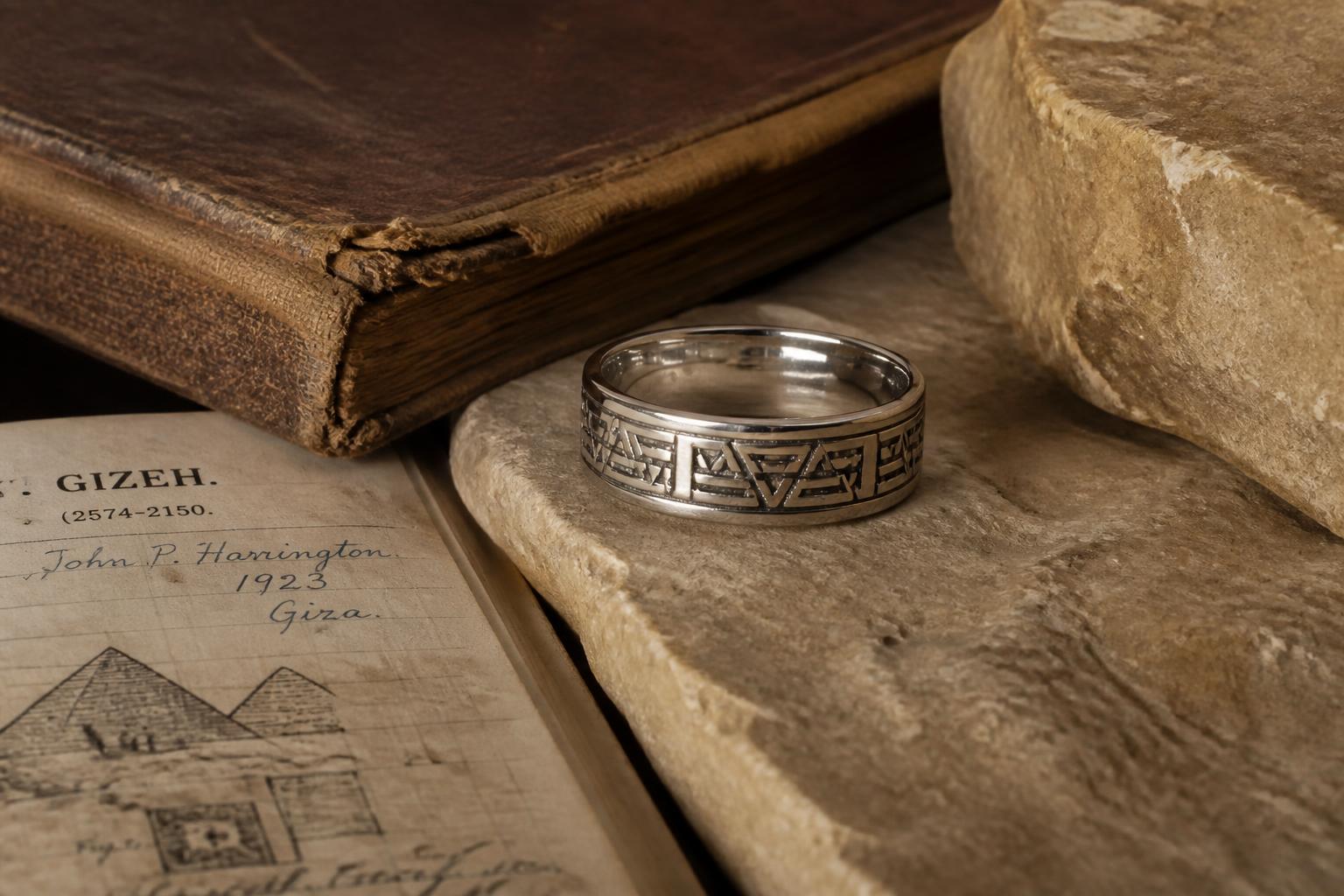
It is called the Atlantis Ring, yet the popular story places its discovery in Egypt. That contradiction is the beginning of the mystery, not its solution.
A name that arrives before the evidence
The Atlantis Ring is one of those objects whose reputation is easier to trace than its archaeological provenance. In the popular account repeated within radiesthesia circles, a ring or ring-like object was found in Egypt in the nineteenth century, sometimes around 1860, and later came into the possession of the French radiesthesist Andre de Belizal through family connections. The object was said to carry a distinctive geometric arrangement of bars, triangles and channels. Belizal and later writers attributed protective or balancing properties to this pattern.
Then the story acquires its strangest feature: an object supposedly found in Egypt becomes "Atlantean."
Why?
There is no accepted archaeological discovery of Atlantis that could supply such a label. Plato's Atlantis is a literary account from antiquity, not a proven excavated civilisation whose jewellery has been catalogued. The name therefore belongs to the object's later interpretive history. It tells us what people came to believe about the pattern, not where the object has been scientifically demonstrated to originate.
Provenance is the first question
Archaeology depends on context. Who excavated an object? In which tomb or layer? What was found beside it? Was the excavation recorded? Where is the original now? What material is it made from? Has it been dated?
The modern Atlantis Ring tradition is weak at precisely these points. The familiar origin narrative is preserved mainly in later books, family stories, commercial descriptions and radiesthesia literature rather than in a standard archaeological excavation report or museum catalogue entry that would allow researchers to reconstruct the chain of custody.
This does not prove that no nineteenth-century object existed. It means the extraordinary parts of the story cannot simply be treated as established archaeology.
That distinction is essential to Madame Monsieur's method: **a tradition can be historically real as a tradition without every claim inside that tradition being historically verified.**
The geometry itself
The pattern usually sold today as the Atlantis or Luxor design is highly recognisable. Repeated rectangular forms are arranged around the circumference, often with triangular elements and parallel grooves. Radiesthesia traditions describe these as "waves of form" — the idea that geometry itself generates or organises subtle energetic effects.
There is an important physical truth hidden inside a much larger claim: shape absolutely can affect fields and waves. Antenna geometry affects electromagnetic behaviour. Cavity shape affects acoustic resonance. The geometry of a conductor changes charge distribution. Optical structures manipulate light.
But moving from that fact to the claim that a small engraved ring creates a specific protective field around the human body requires measurement. The existence of geometry-sensitive physics does not automatically validate every radiesthetic interpretation of geometry.
This is exactly why the ring is a useful object to think with. It sits between two worlds that often borrow each other's vocabulary.
Radiesthesia: instrument, intuition and controversy
Radiesthesia includes practices such as dowsing with rods or pendulums to detect water, substances, conditions or purported energetic qualities. Practitioners developed elaborate vocabularies of vibration, polarity, resonance and subtle fields. Andre de Belizal became associated with this world and with instruments intended to classify "waves" or energetic qualities.
Modern physics also studies vibration, polarity, resonance and fields — but those words have precise operational definitions and measurable units. The use of the same word does not mean the same phenomenon is being described.
A rigorous experiment with the Atlantis Ring would therefore ask very simple questions. Does the ring produce a reproducible electromagnetic signature beyond that expected from its material and shape? Does orientation matter? Does a patterned ring differ from an otherwise identical smooth control ring? Can blinded participants identify the patterned ring at rates above chance? Are physiological changes reproducible when expectation is controlled?
These experiments would not insult the tradition. They would finally give it the kind of test its strongest claims require.
Why Atlantis?
Atlantis became one of the most powerful containers for Western lost-civilisation ideas. Once a technology or symbol is described as too advanced, too strange or too elegant for its assumed context, Atlantis is often recruited as an explanation. The label can function almost like a cultural magnet: it attracts unexplained geometry, ancient engineering, crystals, energy systems and vanished knowledge.
The irony is that calling the ring "Atlantean" can distract from a potentially richer question: what if its real story is about modern Europe imagining ancient Egypt?
Nineteenth- and twentieth-century Europe repeatedly transformed Egyptian motifs into esoteric systems. Egypt was simultaneously archaeological reality and symbolic screen. Temples, pyramids, hieroglyphs and sacred geometry became raw material for new mystical philosophies. The Atlantis Ring may belong as much to this history of reception as to the ancient world it claims to echo.
Carter and the protection legend
Versions of the story sometimes connect the ring with Howard Carter, suggesting that its protective geometry spared him from the famous "curse" associated with Tutankhamun's tomb. This is an excellent example of how legends grow by attaching themselves to famous historical events. The curse itself was heavily amplified by newspapers and later popular culture. Carter's survival became available as evidence for whatever protective object a later story wished to place near him.
Without documentary evidence that Carter possessed and relied on this ring, the story should remain labelled as legend, not biography.
How the ring should actually be studied
The most interesting future research would be almost boring in its discipline.
First, identify the earliest printed description of the ring and the earliest surviving physical example.
Second, establish material composition using non-destructive analysis.
Third, compare the motif with securely dated Egyptian jewellery and architectural patterns rather than comparing by visual resemblance alone.
Fourth, reconstruct the exact radiesthetic experiments attributed to Belizal, including controls.
Fifth, test the geometry as geometry: electromagnetic modelling, resonance, static charge distribution and human perception.
The result might disappoint both believers and sceptics because it may not produce a single answer. We could discover that the physical ring is modern while the geometry has interesting measurable properties. Or that the pattern is historically derivative but psychologically powerful. Or that the entire reputation rests on a twentieth-century symbolic system.
Any of those outcomes would still be a fascinating story.
Closing thoughtThe most mysterious thing about the Atlantis Ring may not be whether it came from Atlantis. It may be how easily a shape can acquire a civilisation, a technology and a mythology simply because no secure provenance arrived first.
— Madame Monsieur