The Sound Inside the Pyramid — What Were the Chambers Designed to Hear?
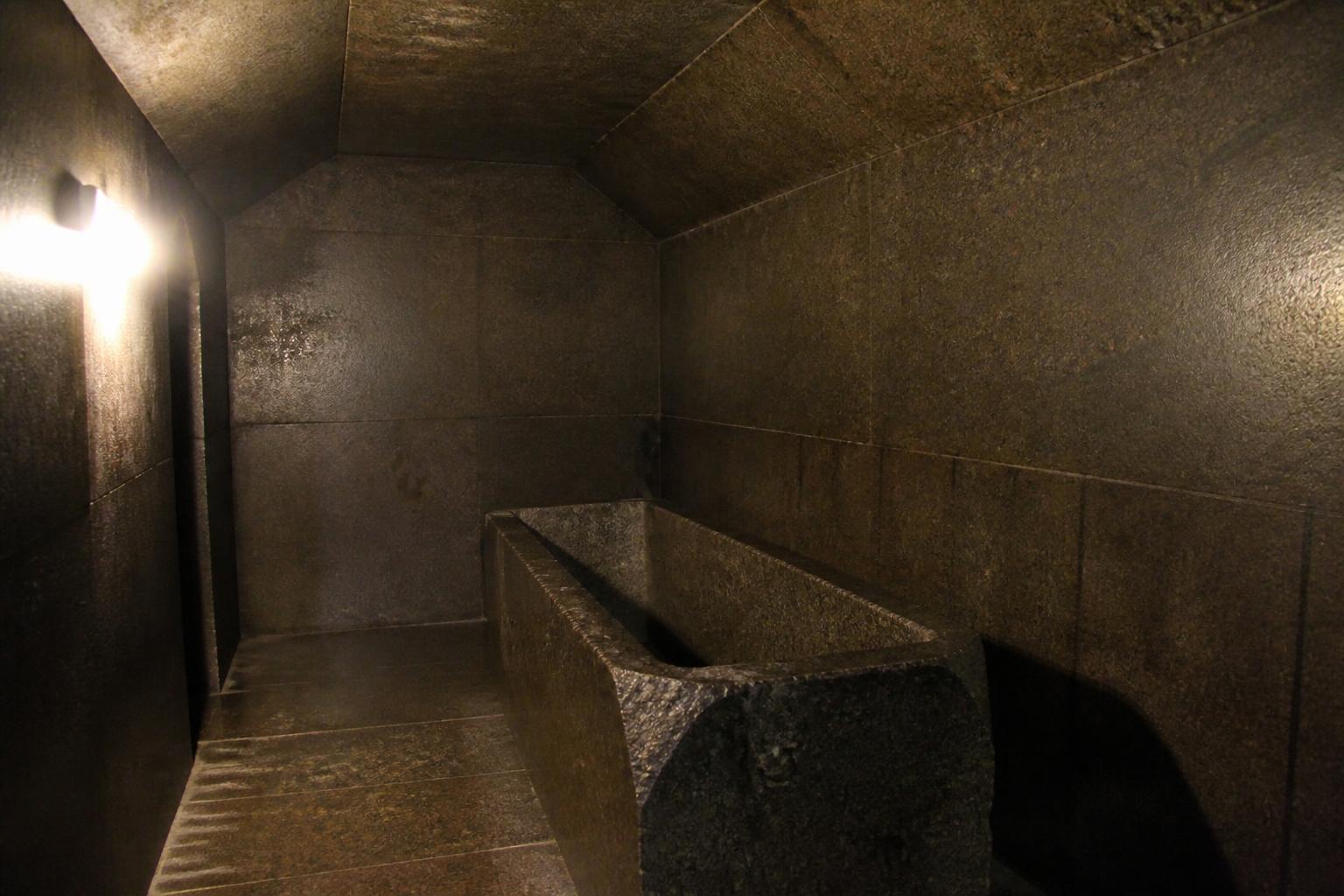
Stand in a stone chamber, remove modern noise and speak one sustained note. The room answers. The question is whether ancient builders expected that answer.
A room that answers back
Sound is invisible architecture. A wall does not merely stop air; it reflects pressure waves. A ceiling creates delays. Parallel surfaces create standing waves. Volume determines which wavelengths fit comfortably inside a room. Hard stone preserves acoustic energy longer than soft furnishings. Change the dimensions and the voice changes with them.
This means that every chamber in the Great Pyramid is also an acoustic object.
For generations, visitors have described the King's Chamber as unusually resonant. Anecdote, however, is not measurement. Recent archaeoacoustic work has begun to document the impulse response and spectral behaviour of the King's Chamber, Queen's Chamber and Subterranean Chamber. The simple fact that they have distinctive acoustic signatures is expected from physics. What remains open is cultural intent.
The King's Chamber as resonator
The King's Chamber is built largely of granite and has a simple rectangular form. In acoustics, simplicity can be powerful. Opposing surfaces allow standing-wave modes to develop at frequencies related to the room dimensions and speed of sound.
If a person chants, hums or strikes a tone close to one of those modes, parts of the sound field can become noticeably reinforced. At other frequencies, interference can create weak zones. The listener may experience the sound not as coming from a single mouth but as occupying the room.
This is not paranormal. It is what resonant cavities do.
But phenomenology matters. Imagine experiencing it without electric light, loudspeakers, traffic noise or a scientific concept of standing waves. A voice appears to grow beyond the body. In a ritual culture where spoken names and formulas could perform religious work, such an experience could acquire profound meaning.
Did Egyptians use chant?
Ancient Egyptian ritual included recitation, hymns, lamentation, temple music and spoken formulae. The Egyptian concept often translated as heka cannot be reduced to stage magic. Words, names and ritual action belonged to a worldview in which correctly performed speech could participate in maintaining cosmic and social order.
That does not prove pyramid chambers were built as chant rooms. There are no surviving operating instructions saying, "Sing this frequency here." But we should avoid the opposite error of assuming acoustics would have been irrelevant to a culture deeply invested in voiced ritual.
Builders do not need frequency analysers to notice resonance. A mason, priest or worker only needs to make a sound.
Why different chambers matter
If every chamber sounded the same, acoustic intent would be harder to discuss. Different dimensions, materials and connections produce different responses. The Queen's Chamber, King's Chamber, Grand Gallery and Subterranean Chamber create radically different spatial experiences.
A proper research programme would therefore map them as a connected acoustic network. What happens when sound is generated in one chamber and measured in another? Do shafts transmit or filter certain bands? How do passages behave as narrow acoustic waveguides? How much coupling occurs through the stone itself as structure-borne vibration rather than through air?
These are testable questions.
Air-borne sound versus stone-borne vibration
Human hearing encourages us to think of sound as something travelling only through air. But vibration can propagate through solids as well. Strike one side of a stone and energy spreads through the material. In a massive masonry structure, airborne acoustics and structural vibration are related but distinct systems.
The 2026 ambient-vibration study of the Great Pyramid, which identified fundamental structural frequencies around 2.0-2.6 Hz, concerns motions far below ordinary musical pitch. Human ears do not hear 2.3 Hz as a normal tone. That frequency describes slow structural behaviour, not a mystical hum audible in the chamber.
This distinction is crucial because internet discussions often combine "2.3 Hz structural resonance," "audible chamber resonance" and "electromagnetic resonance" as if they were one frequency. They are not.
A fascinating structure can host many resonant phenomena at very different scales.
Can resonance alter perception?
Yes, but the details matter. Repetition, reverberation, low-frequency sound, darkness, expectation and ritual context can influence attention, emotion and bodily awareness. Music and chant can alter breathing patterns and group synchrony. Echo can distort spatial localisation. Strong low-frequency sound can be felt as vibration.
None of these effects require a hidden technology.
Nor do they prove claims about activating DNA, opening portals or generating altered states at one universal sacred frequency. Those claims require their own evidence.
The scientifically interesting territory is already rich enough: architecture changes perception by shaping sensory input.
The Grand Gallery question
The Grand Gallery invites speculation because it is long, steep and geometrically unusual. Its corbelled walls and dimensions make it visually and acoustically unlike an ordinary corridor. Could it have influenced sound travelling between lower and upper spaces? Could it have supported ritual procession where footsteps, voices and instruments changed as participants ascended?
These possibilities can be modelled without inventing missing machinery. A detailed LiDAR-based acoustic simulation could compare the real gallery against simplified alternatives. If the actual architecture produces distinctive effects that disappear when the corbelling is removed, we learn something about the consequences of design.
Intent would still require historical interpretation, but the physical phenomenon would be clear.
A chamber as instrument
An instrument is not defined by electricity. A flute is geometry controlling air. A drum is a stretched membrane controlling vibration. A cathedral is architecture shaping voices. A cave can become an instrument when people choose where to sing.
So could a pyramid chamber be an instrument?
Physically, yes — in the broad sense that it filters and reinforces sound.
Historically, we do not yet know whether that was a primary design objective.
This is where the most interesting version of the question survives. Perhaps builders intended a burial or ritual chamber and discovered its voice during construction. Perhaps acoustic effects influenced later choices. Perhaps the sound meant nothing to the original builders and everything to modern visitors.
The building cannot tell us directly which story is correct. But it can be measured more carefully than ever before.
Closing thoughtEvery chamber resonates. The mystery begins only after that fact. Did the builders of the Great Pyramid merely create a room that answered the human voice - or did they know exactly what kind of answer they were building?
— Madame Monsieur