Stone, Water, Sound, Geometry — Was the Great Pyramid Designed as One System?
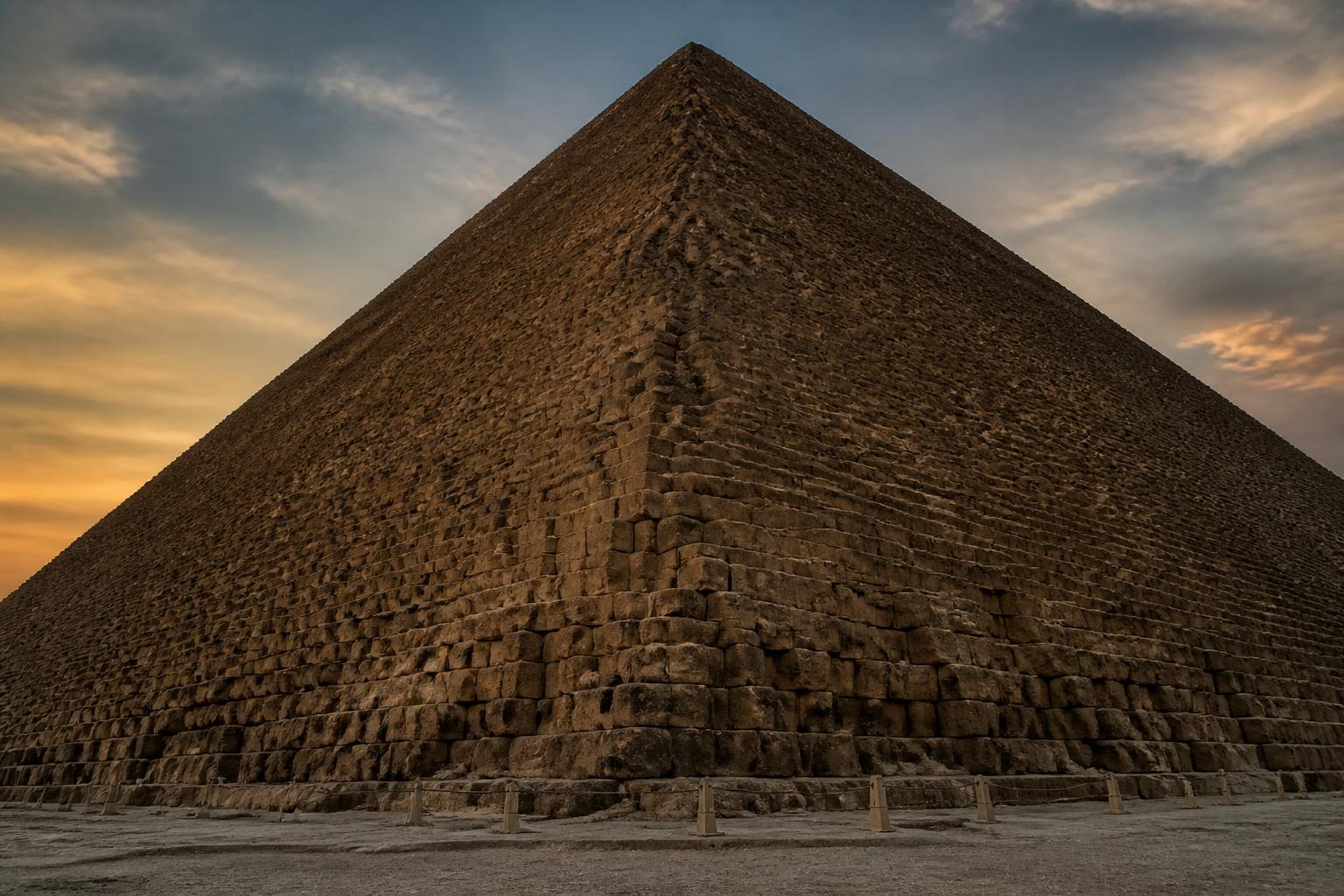
The Great Pyramid is usually discussed as architecture. But what happens when we stop looking at stone, chambers, resonance, voids and geometry separately and ask whether they interact as one physical system?
The danger of starting with the answer
There are two easy ways to write about the Great Pyramid. One is to reduce every strange feature to "just a tomb." The other is to declare it an ancient power plant and reinterpret every stone as machinery. Both approaches start with an answer and force the evidence to obey it.
A better approach is to begin with components.
Stone. Geometry. Chambers. Passages. Voids. Ground. Temperature. Sound. Structural vibration. Electromagnetic behaviour. Human ritual.
Each can be studied independently. The more difficult question is whether any of them were intentionally designed to work together.
STONE — limestone outside, granite where it matters
Most of the Great Pyramid is limestone, while granite appears in crucial internal zones including the King's Chamber and structural elements above it. Granite is dense and mechanically different from limestone. It commonly contains quartz, feldspar and mica. Quartz is piezoelectric: when a suitable quartz crystal is mechanically stressed, electric charge can develop across it.
That fact is real. The leap to "therefore the King's Chamber generated useful electricity" is not.
Granite is a polycrystalline rock. Its quartz grains have varied orientations, and a massive granite block is not equivalent to a deliberately cut electronic quartz resonator. To demonstrate an energy device, we would need evidence for controlled excitation, conductors, collection, switching, loads or another identifiable energy pathway.
Still, material choice matters. Even if granite was selected for strength, prestige or construction reasons, its acoustic and mechanical behaviour becomes part of the chamber's physical reality.
SOUND — a stone room cannot avoid resonance
In 2026, a measurement-led archaeoacoustic study compared impulse responses in chamber spaces of the Great Pyramid, including the King's Chamber, Queen's Chamber and Subterranean Chamber. The basic result should not be sensationalised: enclosed stone spaces resonate. Their dimensions and materials shape decay time, standing waves and spectral response.
But measurement matters because it replaces vague descriptions such as "the chamber hums" with reproducible acoustic data.
This opens a historical question. Did the builders merely create resonant spaces as an unavoidable consequence of architecture, or did they notice and use those effects? Ancient Egyptian ritual placed enormous importance on voiced language, names, recitation and performative utterance. A resonant stone chamber would transform a voice whether or not its builders possessed modern acoustic equations.
Intent remains unproven. Experience does not.
VIBRATION — the pyramid has a structural frequency
A 2026 Scientific Reports study used ambient vibration measurements at 37 locations within and around the pyramid. It found broadly uniform fundamental frequencies around 2.0 to 2.6 Hz, averaging about 2.3 Hz, while adjacent ground showed a different dominant response. The authors interpreted the findings in the context of structural homogeneity and earthquake resilience.
This is one of the most important disciplines to maintain: **a measured frequency is not automatically a sacred frequency.** Buildings, bridges, towers and geological formations all have normal modes of vibration. Engineers care because resonance can amplify motion and cause damage.
Yet once again, the result shows that the Great Pyramid is not merely a static pile of blocks. Physically, it is a massive dynamic structure responding to environmental excitation.
GEOMETRY — shape changes wave behaviour
A 2018 theoretical study modelled the electromagnetic response of the Great Pyramid at radio wavelengths under simplified assumptions. The model found that, under particular resonant conditions, electromagnetic energy could concentrate in internal chambers and in regions beneath the base.
The authors were not claiming to have discovered the pyramid's ancient function. The study used simplified material assumptions and investigated what the geometry would do to electromagnetic waves. The lesson is more subtle: **shape can redistribute energy even when no one intended it to become a machine.**
This gives us a useful experimental question. If a geometric structure displays interesting resonance under modelling, how much of that behaviour survives when realistic materials, cavities, cracks, missing casing stones and ground conditions are introduced?
THE HIDDEN VOID — evidence that the interior story is incomplete
In 2017, the ScanPyramids collaboration used cosmic-ray muons to detect a large previously unknown void above the Grand Gallery, at least about 30 metres long. The detection was reproduced using multiple muon technologies. Its function remains unknown.
This discovery is important not because it proves a hidden machine, but because it demonstrates something humbling: even after centuries of exploration, a major internal feature could remain unseen.
The correct response to an unknown space is not to fill it with our preferred theory. It is to refine the map.
WATER — where hypothesis becomes vulnerable
Water is frequently introduced into alternative models of the pyramid. Proposed roles include hydraulic pressure, acoustic coupling, vibration, electrical processes and chemical reactions. Water genuinely can transmit mechanical waves, affect foundations, conduct ions and participate in electrochemistry.
But an integrated hydraulic system requires archaeological evidence of controlled intake, channels, reservoirs, seals, valves, flow direction or mineral deposits consistent with repeated operation. The existence of groundwater or subterranean cavities alone is not enough.
This is where the most dramatic pyramid theories often weaken. They assemble individually real physical facts — water moves, quartz is piezoelectric, chambers resonate — and treat their coexistence as proof of a designed machine. A system is demonstrated not by listing components, but by showing functional connection between them.
What would count as evidence for an integrated system?
Imagine rebuilding the hypothesis as an engineering problem.
A true integrated system should produce predictions that differ from a tomb-and-monument model. It might predict unusual wear at fluid boundaries. It might require channels with specific slopes. It might predict electrical residue, chemical deposits, electrodes, conductive pathways, a repeatable acoustic coupling between chambers, or an energy concentration measurable only when certain spaces interact.
The stronger the hypothesis, the more specific the prediction.
This is why a scaled physical model and high-resolution digital twin would be valuable. Start with exterior geometry only. Add known chambers. Then add material differences. Add realistic ground. Add water in explicitly defined locations. Excite the structure mechanically and acoustically. Measure what changes at each step.
If the remarkable effect appears only after adding a feature the ancient builders deliberately created, that feature becomes interesting. If it appears in any pyramid-shaped block of stone, the explanation shifts toward geometry rather than technology.
Ritual and machine are not opposites
Modern thinking often forces an ancient monument into one category: religious or technological. Ancient societies did not necessarily divide the world that way. Architecture could organise bodies, sound, astronomy, procession, political power and cosmology at once.
A chamber can be structurally necessary and ritually meaningful. A passage can solve an engineering problem and control movement. Resonance can be accidental in origin and intentionally used once noticed.
The most sophisticated question may therefore be neither "tomb or power plant?" nor "ritual or technology?" It may be: **which physical effects did the builders understand experientially, and which did they intentionally incorporate into ceremonial design?**
Closing thoughtThe Great Pyramid undeniably behaves as a physical system because every massive structure does. The unresolved question is whether its builders merely mastered construction - or also mastered some of the behaviours that construction created.
— Madame Monsieur