Tarot — From Playing Cards to Forbidden Symbols
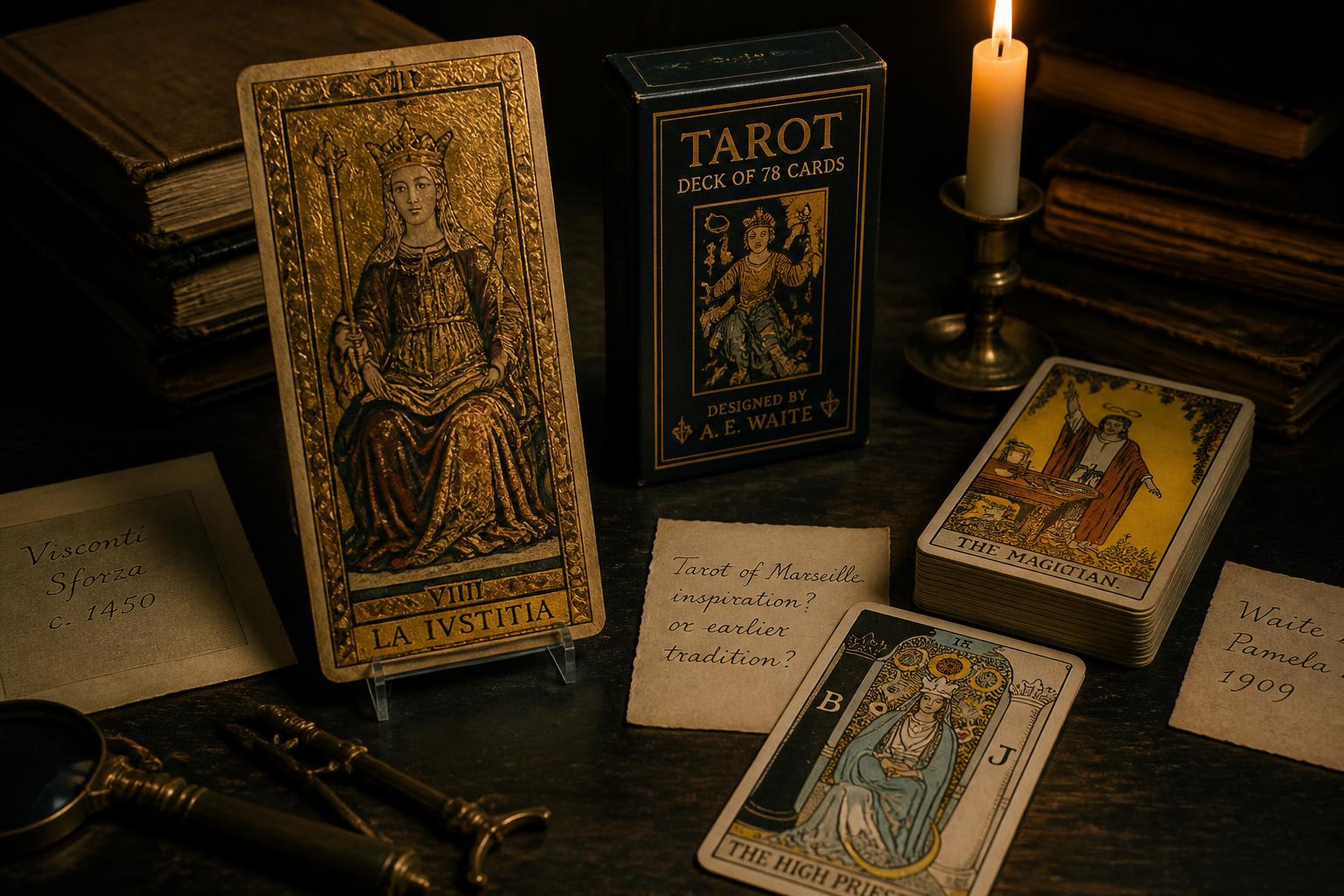
Tarot did not begin as a forbidden book disguised as cards. It began as a game. Its later transformation into a symbolic mirror of fate, psyche and occult philosophy is exactly what makes its history so compelling.
Before the cards became an oracle
Ask someone today what tarot is and the answer may include prophecy, intuition, archetypes, magic, shadow work or spiritual guidance. Yet the earliest documentary trail leads somewhere more ordinary: northern Italy in the fifteenth century. References to tarot cluster around courts and cities such as Milan, Venice, Florence and Urbino. Surviving luxury decks associated with the Visconti and Sforza families were painted objects of status as well as playing cards. They used familiar Italian suits — Cups, Swords, Batons and Coins — with an additional series of illustrated triumph cards.
The original game was a trick-taking game. That matters because it immediately removes one of the most persistent myths: tarot was not discovered in an Egyptian temple, brought secretly from Atlantis, or created as an occult book in card form. Those stories belong to later centuries. The historical cards were born in a culture where allegory was everywhere. Virtues, rulers, Death, Fortune, Love, celestial bodies and religious figures could appear in art without functioning as a secret code.
But this does not make the images empty. Quite the opposite. A fifteenth-century viewer lived in a world saturated with visual symbolism. A Wheel of Fortune, a pope, an emperor, a skeleton, a star or a personification of Justice carried layers of cultural meaning before anyone asked the cards to predict tomorrow.
How a game acquired a second life
The decisive transformation came much later. In eighteenth- and especially nineteenth-century Europe, occult writers began connecting tarot with ancient wisdom, Kabbalah, astrology, Egypt and ceremonial magic. These systems were often historically speculative, but they were intellectually productive: they reorganised the cards into symbolic architectures that continue to shape modern practice.
By the time decks such as the Rider-Waite-Smith appeared in the early twentieth century, tarot had become something different from its courtly ancestor. Pamela Colman Smith's illustrated minor arcana gave narrative scenes to cards that earlier decks often treated more simply. A person could now look at almost any card and enter a miniature psychological drama.
This is one reason tarot survives. Its pictures are structured but incomplete. They suggest a story without fixing one. A tower falls, a figure walks toward a horizon, cups are offered or spilled, a woman sits between pillars. The viewer supplies memory, fear, desire and context.
Why the Church objects — and what it actually objects to
The phrase "the Church banned tarot" is too simple. The Catholic Catechism does not need to name a particular deck to reject the practice most commonly associated with it. Paragraph 2116 rejects forms of divination intended to unveil the future, alongside astrology, omens, clairvoyance and mediumship. The theological objection is therefore directed primarily at divination and attempts to seek hidden power or foreknowledge outside divine providence, not at a piece of painted card as a material object.
This distinction explains an apparent contradiction. A museum can display a fifteenth-century tarot deck as art and social history while a church can reject the use of a modern deck for fortune-telling. The same physical object can participate in radically different practices.
Historically, playing cards themselves were sometimes criticised by religious and civic authorities because of gambling, idleness or moral disorder. That is different from the later occult controversy. Over time those histories became compressed into one dramatic idea: tarot was always forbidden. The real story is less cinematic but more interesting.
Tarot as a psychological device
Modern psychology gives us another way to understand why tarot can feel uncannily personal without assuming that a card objectively predicts the future. Humans are extraordinary pattern-makers. We interpret ambiguous images through current concerns. In psychology, projection describes the way inner material can be attributed to or discovered in external things. Narrative psychology studies how people build coherent stories out of events. Archetypal approaches, especially those influenced by Carl Jung, explore recurring figures such as the mother, shadow, trickster, ruler, death and rebirth.
Tarot concentrates these processes into a controlled symbolic environment. A spread gives the mind a set of constraints. Instead of asking, "What do I feel?" — an almost limitless question — a person asks, "Why does this image of a closed gate disturb me?" or "Why did I immediately read this card as freedom rather than loss?" The card becomes a prompt.
That does not prove every reading is psychologically useful. Suggestibility, confirmation bias and the Barnum effect — accepting vague statements as uniquely personal — can also be powerful. A responsible reading therefore distinguishes reflection from certainty.
The strange power of sequence
Tarot is especially compelling because it is not one symbol but a system. The Major Arcana can be read as a sequence of transformations: innocence, authority, desire, collapse, death, balance, temptation, illumination and completion. Modern occultists often call this the Fool's Journey. It is not a proven ancient doctrine; it is a later interpretive framework. Yet frameworks matter. Human beings use sequence to turn fragments into meaning.
The same happens in myth, ritual, theatre and psychotherapy. A beginning state is disrupted. A threshold is crossed. Something is lost. Something is learned. The person returns altered. Tarot is unusually efficient at generating this grammar of change.
Symbol, mirror or oracle?
There are at least three honest ways to approach tarot today.
The first is historical: a family of card games born in Renaissance Italy.
The second is symbolic and psychological: a visual language capable of stimulating association, memory and narrative.
The third is spiritual: a divinatory or intuitive practice whose metaphysical claims depend on the worldview of the practitioner.
Trouble begins only when these layers are confused. Historical scholarship cannot prove that a spread is guided by an invisible intelligence. A meaningful personal experience cannot rewrite the documented origin of the cards. And scepticism about prediction does not erase the extraordinary cultural life the cards have accumulated.
Tarot may be most interesting precisely because it sits at that boundary. It is a game that became a ritual, art that became a mirror, and a set of images that people repeatedly ask to speak.
Closing thoughtPerhaps the deepest question is not whether the cards know the future. It is why, when a random image appears before us, the human mind so quickly recognises a story it feels it already knew.
— Madame Monsieur