Before the Alphabet — When a Mark Became Meaning
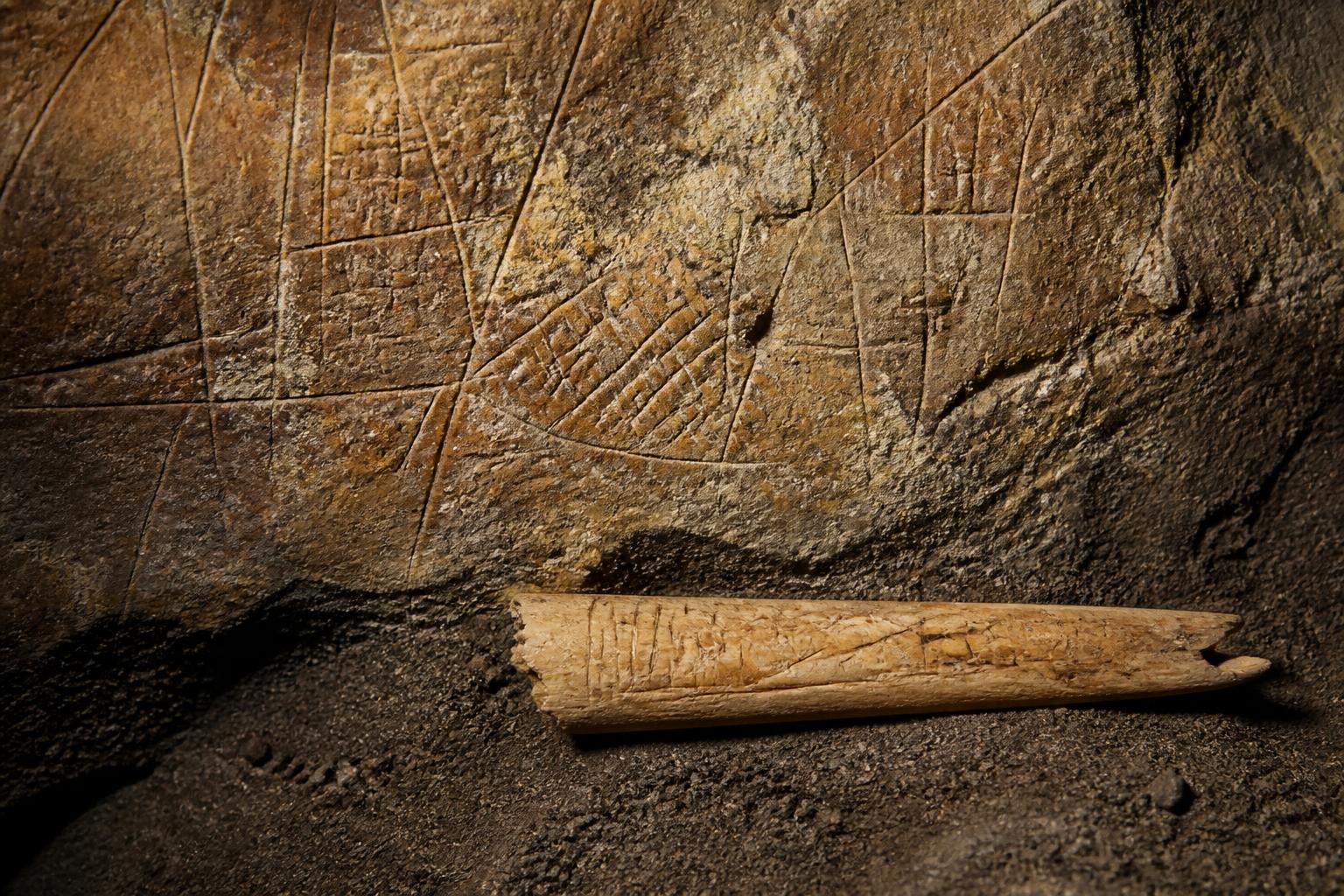
Long before A, B and C, humans cut marks, counted objects, drew animals and built visual systems. The alphabet was not the beginning of writing. It was one extraordinary simplification in a much older history.
The first mark was not yet a letter
A line cut into bone can count. A painted animal can remember a hunt. A seal can identify ownership. A repeated sign can classify grain. Writing emerges only when marks become part of a conventional system capable of representing language or structured information beyond the immediate object.
That boundary is difficult to draw because symbolic behaviour is much older than writing.
Humans made meaningful marks tens of thousands of years before the first urban writing systems. Some were decorative. Some may have recorded quantity or identity. Some belonged to ritual. We cannot assume every repeated notch was a sentence waiting to be decoded.
The invention of writing was therefore not the moment humans discovered symbols. It was the moment symbols became increasingly systematic, transmissible and administratively powerful.
Clay, accounting and the pressure of civilisation
In Mesopotamia, early writing grew in a world of expanding settlements, storage, labour and exchange. Clay tokens and impressions were used in accounting traditions before full cuneiform writing developed. Over time, marks on tablets became capable of recording commodities, numbers, names and eventually language.
This is a recurring pattern in technological history: the breakthrough is not always invented for philosophy or poetry. Bureaucratic pressure can create tools that later become capable of literature.
Once a system can record who owes how much barley, it can eventually record a king's victory, a legal dispute, a hymn or an epic.
Writing moved memory out of the nervous system and into matter.
Egypt: image and sound at once
Egyptian hieroglyphic writing demonstrates why our modern distinction between "picture" and "letter" can be misleading. A sign could depict an object yet function phonetically. Other signs could represent whole words or help classify meaning.
The writing system was visually rich because it did not have to choose between image and sound.
To a modern reader trained in alphabetic writing, this can seem complicated. To an Egyptian scribe, it was a flexible system with its own grammar.
The lesson is important: the alphabet is not the natural endpoint toward which all writing must evolve. It is one solution among many.
The radical idea: one sign, one consonantal sound
The early alphabetic systems associated with the Sinai and Levant introduced a powerful compression. Instead of memorising hundreds of signs, a writer could use a much smaller inventory tied to speech sounds.
The conventional reconstruction of Proto-Sinaitic and later Semitic letter names illustrates the acrophonic principle. A sign resembling an ox head could be associated with the Semitic word *aleph*, "ox," and represent the initial consonantal sound. A house-like form associated with *bet* or *bayt*, "house," represented /b/.
The precise history of individual early signs remains debated, and not every proposed pictorial ancestry is equally secure. But the larger transformation is clear: pictures were abstracted into reusable sound signs.
A drawing stopped needing to mean what it looked like.
That is an extraordinary cognitive move.
A was once turned on its side
The modern capital A does not obviously resemble an ox. Rotate some ancient forms and the ancestral resemblance becomes easier to imagine. Phoenician *aleph* passed into Greek as alpha. Greek speakers repurposed signs for their own sound system and made one of the alphabet's most consequential innovations: systematic representation of vowels.
From Greek, related letterforms influenced Etruscan and then Latin writing. The alphabet on a modern phone screen therefore contains shapes with genealogies stretching back thousands of years.
This does not mean each modern letter still carries a mystical "ox energy" or "house energy." Historical origin is not the same as permanent symbolic essence.
But it does mean ordinary letters are fossils of cultural adaptation.
The alphabet as a technology of reduction
An alphabet succeeds by throwing information away.
When we write the word "tree," the letters do not tell us whether the tree is tall, leafless, sacred, green or burning. They encode speech sounds, while meaning is reconstructed by a reader who already knows the language.
A pictorial system can preserve visual association. An alphabet sacrifices that immediacy for speed, flexibility and a small sign inventory.
This trade-off helped writing travel across languages. A script could be borrowed, modified and reassigned.
What writing changed in the human mind
Writing did not biologically redesign the human brain in a few thousand years. Instead, brains learned to recruit existing visual and language systems for a new cultural skill.
Literacy changes what societies can externalise. Lists can grow beyond working memory. Laws can be stabilised. Accounts can be audited. Long arguments can be compared line by line. A dead person can speak through a document centuries later.
The written mark becomes a form of asynchronous presence.
This may be writing's most profound magic — and unlike supernatural claims, we can observe it every day.
The symbol before the sound
The alphabet also reminds us that visual and acoustic meaning were once more visibly entangled. A sign could begin as a picture, be named as an object, lose the picture's meaning, preserve only a sound, then change shape as it moved across languages.
The result is a layered object.
A letter is not simply a sound written down. It is the endpoint of a historical transformation in which image became name, name became phoneme, and phoneme became abstract form.
Closing thoughtWe usually imagine writing as language made visible. But the oldest alphabetic letters suggest the reverse journey too: images were slowly persuaded to forget what they depicted so that they could begin to speak.
The Language Before Language — When Symbols Spoke Before Words
Long before alphabets, humans made marks that carried attention, memory and identity. But a symbol is not automatically a language, and a mark is not automatically writing. The distance between them is where one of humanity's greatest transformations took place.
Read the essay →— Madame Monsieur