The Crystal Skull Mystery — Archaeology, Legend and the Power of an Object
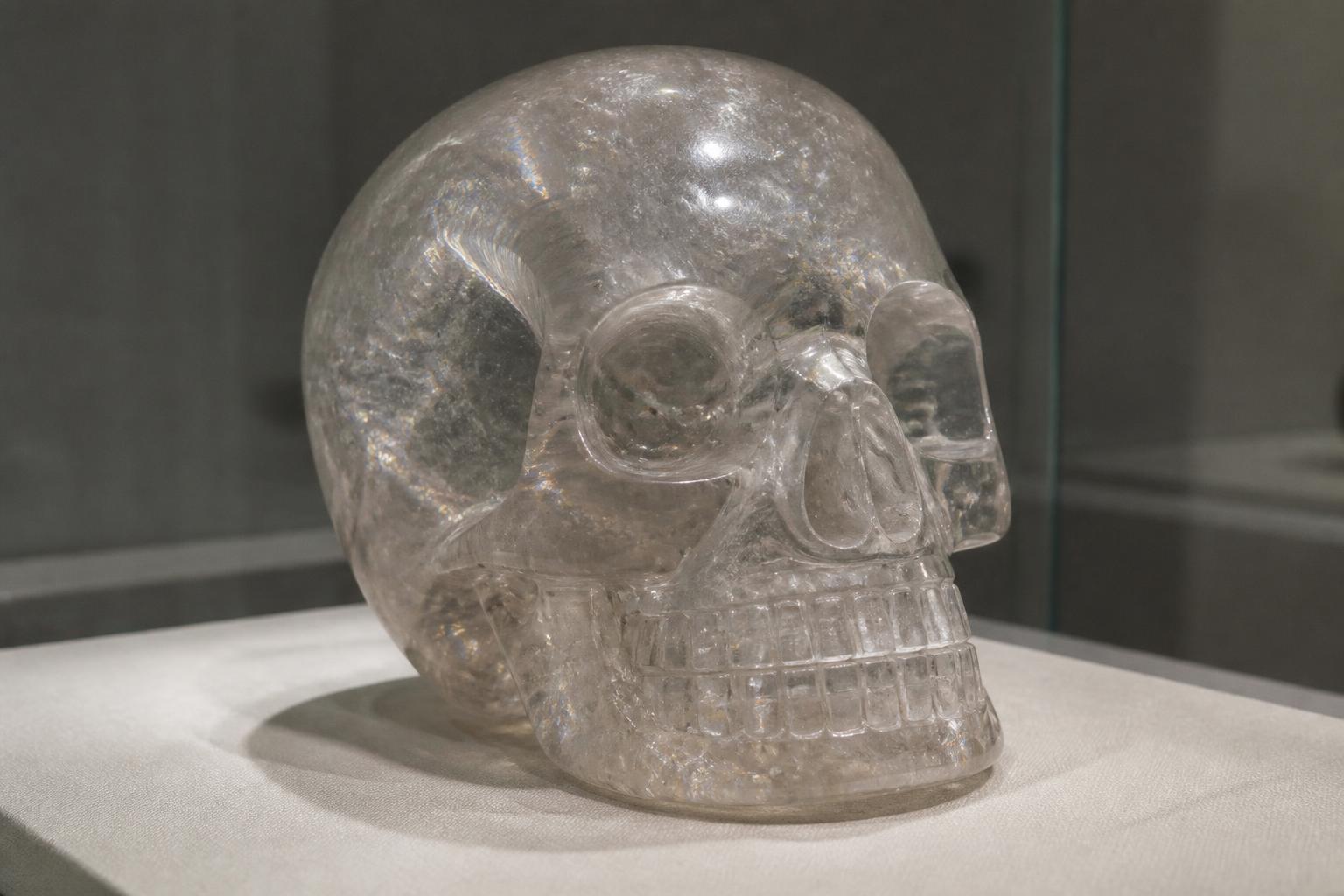
Crystal skulls look as if they belong to an ancient temple. Scientific examination tells a more complicated story - and raises a better question about how objects become sacred after they are made.
An object that appears to arrive with its own myth
A human skull carved from transparent quartz seems almost designed to produce legend. The material is cold, hard and luminous. Light enters, fractures and returns. The familiar geometry of the face becomes alien when rendered in crystal.
Several crystal skulls entered European and American collections in the nineteenth and twentieth centuries, often attributed to pre-Columbian Mexico or Central America. Over time, stories grew around them: lost Mayan knowledge, Atlantean memory, healing powers, prophecy, even sets of thirteen skulls that would one day reunite.
The mythology became larger than the documented archaeology.
The British Museum skull
The British Museum holds one of the best-known examples, a rock-crystal skull acquired from Tiffany & Co. in the late nineteenth century. Its early provenance is uncertain. It was associated with Mexico, but its chain of custody did not resemble that of an object recovered in a controlled modern excavation.
This matters because provenance is evidence. An object that appears suddenly on the antiquities market without secure archaeological context must be evaluated differently from one documented in an undisturbed tomb layer.
The skull's beauty does not resolve its age.
Tool marks as a kind of language
Hard materials remember how they were worked. Abrasive grooves, wheel marks, polishing patterns and microscopic surface features can reveal manufacturing techniques even when no written record survives.
Scientific examinations of famous crystal skulls have found evidence consistent with relatively modern rotary tools and abrasives in examples once promoted as ancient Mesoamerican artefacts. Such findings weaken claims that those particular skulls were carved with pre-Columbian methods.
This is an important lesson in archaeological mystery: **the object may be silent, but the manufacturing process leaves a grammar.**
The Mitchell-Hedges legend
The most famous crystal skull story is associated with F. A. Mitchell-Hedges and his adopted daughter Anna. Later retellings claimed that Anna discovered a spectacular crystal skull at the Maya site of Lubaantun in Belize in the 1920s.
Documentary research has complicated this account. Evidence shows Mitchell-Hedges obtained the skull through the art market, and the dramatic excavation story emerged later.
Again, this does not make the object uninteresting. It shifts the mystery from "how did the Maya make this impossible object?" to "how and why did a modern object acquire an ancient biography?"
That second question belongs as much to anthropology and psychology as archaeology.
Why quartz invites extraordinary claims
Quartz has real and remarkable physical properties. It can be piezoelectric. It has a crystalline lattice. High-purity quartz is important in optics and electronics. Quartz oscillators help keep time in watches and stabilise frequencies in circuits.
These facts are often used as bridges to much larger claims: that a crystal skull stores ancient information, amplifies thought, transmits consciousness or functions as a lost technological device.
The bridge is not automatic.
A quartz crystal used in electronics works because engineers control its cut, electrodes, circuit conditions and resonance. The fact that quartz can participate in precise technology does not show that any carved quartz object is an information-storage device.
A scientific test would need to identify a mechanism, encoding format and reproducible readout.
Why the legend persists after testing
One might expect evidence of modern manufacture to kill the mystery. It does not.
That is because cultural value is not identical to archaeological authenticity. A modern ritual object can still carry intense meaning. A family heirloom can matter even if its origin story is partly wrong. A crystal skull can become a symbol of lost knowledge because people repeatedly tell that story around it.
This is how relics, icons and talismans work socially: belief and narrative accumulate around material objects.
The skull becomes a container for questions humans already carry — mortality, memory, lost civilisations, intelligence, death, immortality.
The skull as perfect symbolic technology
A skull represents what remains after identity is stripped away. It is recognisably human and radically anonymous. Crystal represents transparency, preservation and order. Combine them and the result almost inevitably suggests "memory preserved beyond death."
This symbolic logic may explain part of the object's power better than any hidden circuitry.
The form itself invites a myth of stored consciousness.
What would change the story?
A genuinely ancient crystal skull recovered in a secure archaeological context, with tool marks consistent with period technology and independently dated associated material, would be important. It would show that ancient craftspeople produced such an object under documented conditions.
It would not automatically prove supernatural powers or information storage. Each claim would still require separate evidence.
This is the discipline mystery needs: every conclusion must be proportional to the evidence that supports it.
A forgery can still reveal truth
Some of the most instructive artefacts in museums are objects once misidentified. They teach us about collecting, colonial markets, scientific methods and the human desire for spectacular origins.
Crystal skulls belong to that category whether individual examples turn out to be ancient, modern or somewhere between. Their story connects archaeology with trade, technology, myth-making and belief.
Closing thoughtPerhaps the crystal skull does store memory after all - not an encoded memory left by a lost civilisation, but the layers of desire, fear, scholarship and imagination that modern people have projected into it.
— Madame Monsieur