The Handbag Before History — Why Does an Ancient Symbol Look So Strangely Familiar?
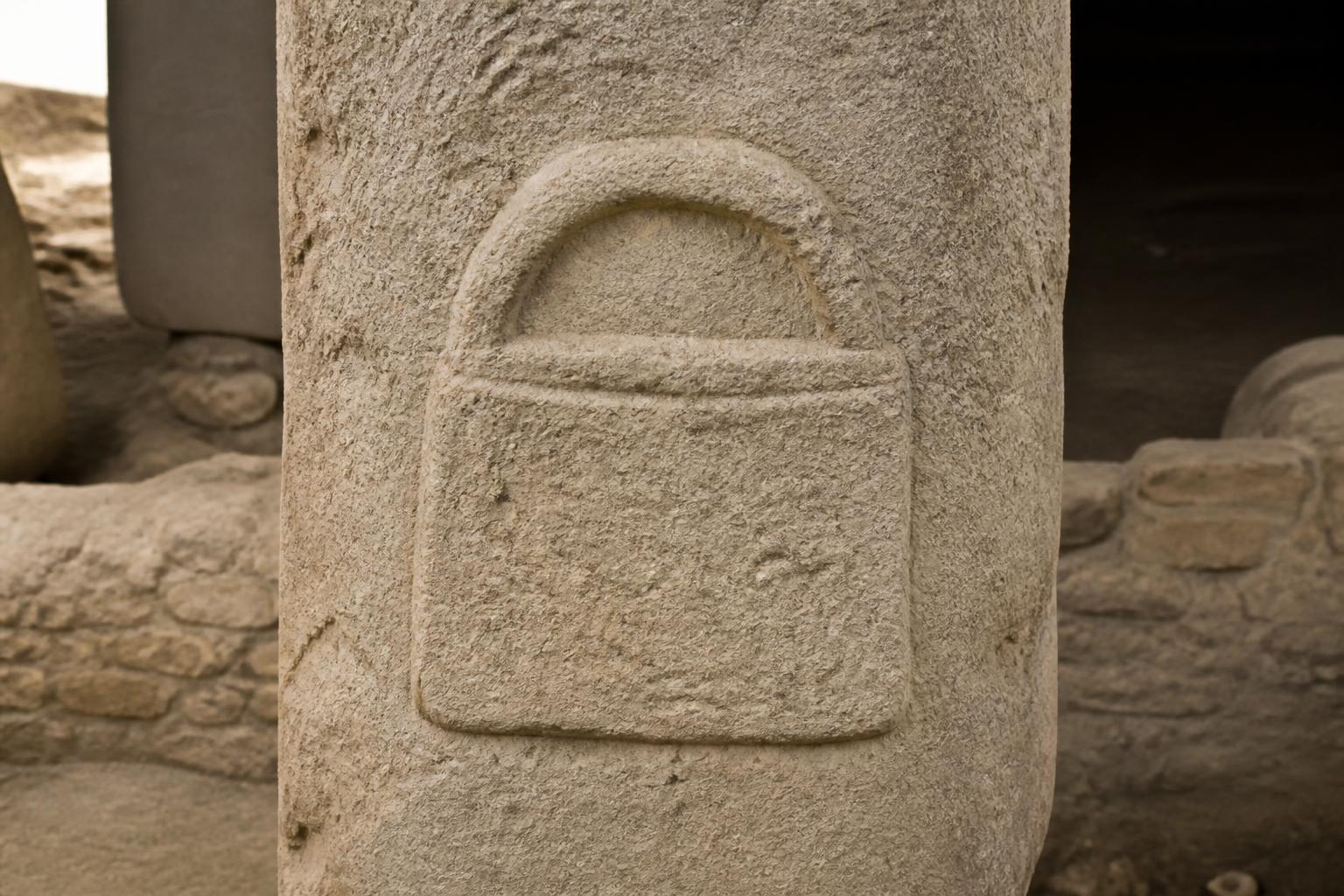
A shape that resembles a modern handbag appears in prehistoric and ancient imagery. But resemblance is not identity - and that gap is where the real story begins.
The problem with familiar shapes
Look at an unfamiliar ancient carving long enough and the modern brain begins naming it. A rectangle with an arch becomes a handbag. A circle with lines becomes a wheel. A pointed form becomes a rocket. This reflex is useful because recognition helps us organise the world. It is also dangerous because once we name a shape, we start importing the function of the modern object into the ancient image.
The so-called ancient "handbag" is a perfect example.
At Gobekli Tepe in southeastern Turkey, monumental T-shaped pillars were erected by communities more than 11,000 years ago. Pillar 43, often called the Vulture Stone, carries a dense visual field of animals, abstract forms and three prominent shapes near the top that many modern viewers compare to bags with handles.
They do look familiar.
But familiarity is not a decipherment.
Gobekli Tepe changes the context
Gobekli Tepe belongs to a period before pottery was widespread in the region, before writing and before the great urban civilisations of Mesopotamia. Its builders nevertheless moved and carved large limestone pillars, organised complex communal spaces and developed a rich visual language.
That alone should make us cautious about describing them as "primitive." Their technology was different from ours, but their symbolic world was clearly sophisticated.
The three bag-like shapes on Pillar 43 do not come with labels. Proposed interpretations include architectural forms, enclosures, abstract signs, containers, celestial imagery and compositional devices. None has achieved universal acceptance.
The honest description is therefore simple: **three repeated shapes with rectangular lower sections and curved or arched upper elements appear in the composition; their meaning remains uncertain.**
Then we move thousands of years forward
In Neo-Assyrian palace reliefs from the first millennium BCE, winged supernatural figures are often shown holding an object that modern viewers also call a handbag. Here, however, the context is much clearer.
The Metropolitan Museum of Art identifies the object as a small bucket. In the other hand, the figure holds a cone-like implement described in Akkadian as a purifier. The gesture appears connected with purification and perhaps also with imagery of date-palm fertilisation. Similar figures flank kings and stylised sacred trees.
So in the Assyrian case, "bag" is a misleading modern nickname. We have stronger evidence that the object represents a ritual vessel.
The visual similarity between Gobekli Tepe and Assyria is therefore intriguing but not enough to establish continuity.
Similar shape does not mean same tradition
Human beings repeatedly invent similar forms because the constraints of function and anatomy are repeated. A vessel held by a hand requires a grip. A roof drawn above a room may resemble a handle. A basket, shrine, doorway or building facade may collapse into comparable simple geometry when carved in stone.
This is a broader problem in comparative symbolism. Two cultures can independently produce circles, spirals, crosses, grids and hand-like forms. Sometimes there is transmission. Sometimes there is convergence. Sometimes modern eyes are doing the connecting.
To demonstrate historical continuity, we would need more than resemblance: intermediate examples, chronology, geographic pathways, consistent context and evidence that the symbol retained related meaning.
Could the prehistoric forms be buildings?
One recent line of interpretation proposes that the Gobekli Tepe shapes might be schematic architectural representations. This is attractive because prehistoric visual conventions need not resemble modern perspective drawing. A rectangle could represent an enclosure or wall; an arched element could represent a roof or upper boundary.
But the interpretation remains a hypothesis. It should be tested against other carvings at Gobekli Tepe and related sites. Do similar shapes appear where architecture is independently indicated? Are proportions consistent? Do they occur in sequences that correspond to known building layouts?
The difference between a good hypothesis and a story is that the hypothesis tells us what evidence could make it stronger or weaker.
Why the handbag became an internet symbol
The bag interpretation became popular because it is instantly legible. It offers a powerful visual shock: "Why is a modern handbag carved into a 12,000-year-old monument?"
From there the story often expands. Similar shapes are gathered from Mesopotamia, Mesoamerica and elsewhere and presented as evidence for a shared lost civilisation, travelling gods or inherited technology.
The difficulty is that these compilations often flatten very different objects into one category. A handled bucket, a ceremonial vessel, a roof-like sign and a rectangular emblem all become "the same handbag." Once that classification is accepted, the conclusion appears built into the evidence.
But classification is the part that requires proof.
The Assyrian bucket is already fascinating
There is no need to turn the Assyrian vessel into a technological case to make it interesting. The repeated scene of supernatural beings performing an act with a bucket and purifier near a sacred tree tells us something profound about ancient political theology.
Purity, fertility, kingship and divine protection were represented as actions. The object in the hand was part of a visual verb.
This suggests another possibility for interpreting older symbols: perhaps some were not nouns at all. A shape may have represented an action, status, place or relationship that we no longer know how to read.
A lesson in visual language
Written language trains us to expect symbols to have stable definitions. Ancient images often work differently. Scale can indicate importance rather than physical size. Repetition can mark ritual rhythm. Animals can carry cosmological roles. A vessel can be both practical object and sacred sign.
The "handbag" question therefore leads into a bigger question: **what happens when a visual language survives but its grammar does not?**
We can see the marks perfectly. We can photograph them at microscopic resolution. Yet the interpretive code is gone.
This is one of archaeology's most beautiful frustrations. Preservation can save the message without saving the key.
Closing thoughtPerhaps the ancient handbag is not evidence that the past looked strangely modern. Perhaps it is evidence that the modern mind has difficulty looking at an ancient shape without immediately giving it a modern name.
Göbekli Tepe and the Question That Refuses to Disappear
Göbekli Tepe did not prove that a forgotten high-tech civilisation built the Neolithic world. What it did was more interesting: it forced archaeology to reconsider how monumentality, ritual, gathering and early settled life could emerge among communities living at the edge of the farming transition.
Read the essay →— Madame Monsieur