Letter, Number, Sound, Image — Were They Ever Truly Separate?
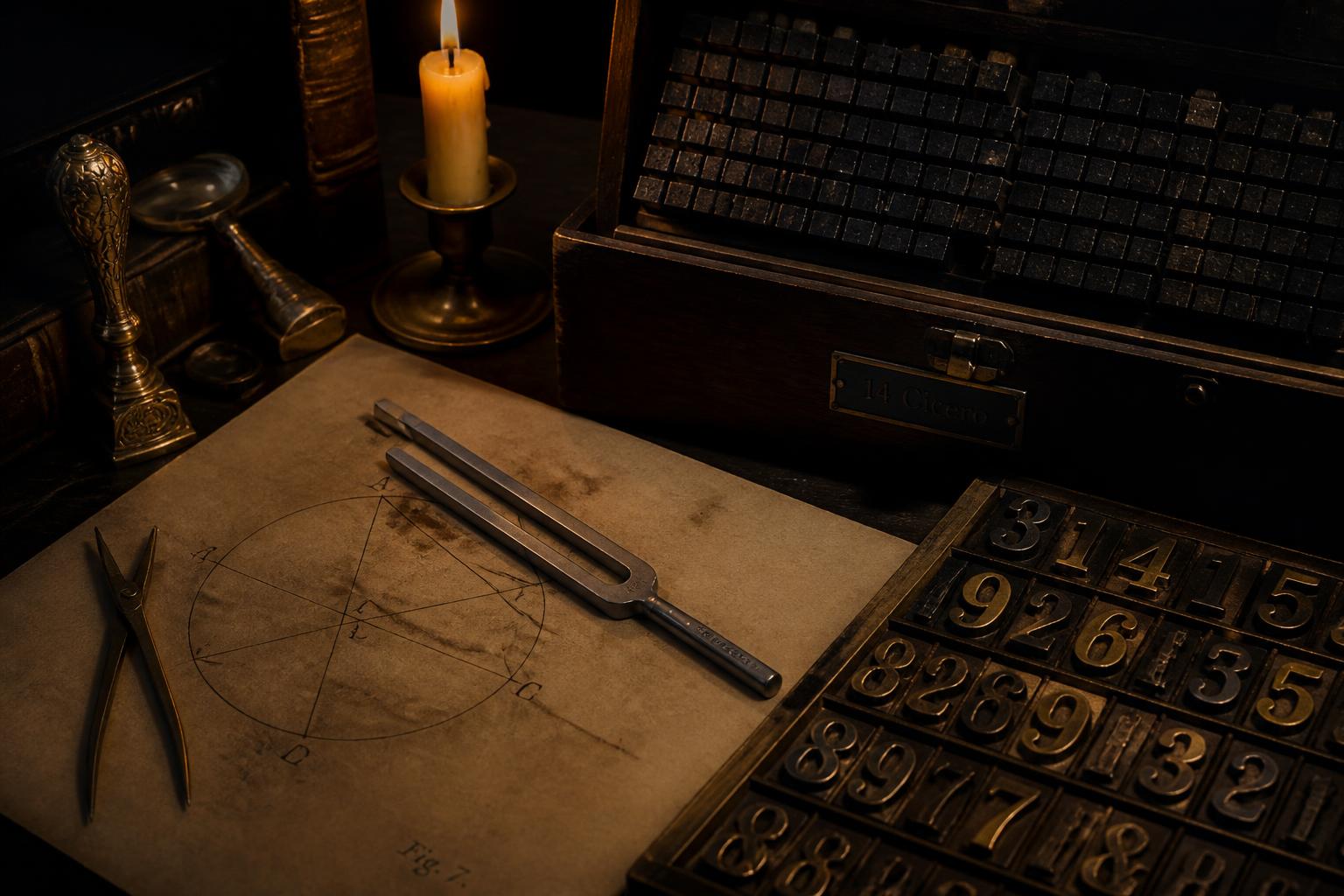
Modern life separates letters, numbers, sounds and images into different systems. Ancient writing traditions repeatedly crossed those boundaries. One sign could be read, counted, spoken and symbolised.
Four categories that feel natural
A child today learns that A is a letter, 1 is a number, a circle is a shape and "ah" is a sound. The categories seem obvious because our education separates them from the beginning.
Historically, the boundaries were often much less clean.
Greek and Hebrew letters could carry numerical values. Roman numerals are letters functioning as numbers. Egyptian signs could operate visually and phonetically. Sacred texts could be interpreted through the numerical value of names. Calligraphy turned written sound into visual form. Music later developed notation that converted sound into geometry on a page.
The human mind repeatedly turns one mode of information into another.
When letters counted
Before Hindu-Arabic numerals became dominant in Europe, alphabetic numeral systems were common. Greek letters represented numbers through systems now called Greek numerals or, in interpretive contexts, isopsephy. Hebrew letters likewise developed numerical values and later became central to gematria traditions.
This means a written name could simultaneously be a sequence of sounds and a sum.
That fact alone does not prove that every ancient name was intentionally engineered to produce hidden numerical messages. But it created the possibility of numerical interpretation wherever alphabetic values existed.
Once a culture knows that words have totals, numerical wordplay becomes almost inevitable.
Rome made letters into arithmetic
Roman numerals provide a more familiar example. I, V, X, L, C, D and M are written characters with numerical functions. The system shows how arbitrary our modern category boundaries really are.
Nothing in the shape X intrinsically makes it "ten." Convention gives it that function.
The same principle governs writing. A mark becomes meaningful because a community agrees how to use it.
Image becoming sound
Early alphabetic history provides another conversion. A pictorial form associated with an object could be repurposed according to the first sound of that object's name. Through time, the sign became increasingly abstract.
This is a transformation from image to lexical name to phoneme.
Once the process is complete, readers no longer need to see the original picture. The visual sign becomes a transparent doorway to sound.
Except it is never entirely transparent. Typography proves that shape continues to affect perception. The same word printed in a severe angular typeface feels different from the same word written in flowing script.
Meaning leaks back into form.
Sound symbolism: when sound behaves like shape
Psychology gives us a modern experimental bridge between sound and image. In the classic bouba/kiki effect, people tend to associate rounded forms with sounds like "bouba" and angular forms with sounds like "kiki." Studies across languages have found robust versions of this cross-modal mapping, though its strength and universality vary with methods and populations.
More recent experiments continue to explore how consonants, vowels, pitch, articulation and visual form interact. In 2026, researchers reported that novel words containing different sound properties systematically influenced the angularity or curvature of figures participants drew.
This does not mean every phoneme has one universal sacred geometry. It means language may be less arbitrary than the simplest textbook model suggests.
Some sounds feel shaped.
Numbers becoming symbols
Numbers themselves also accumulate visual and cultural meaning beyond quantity.
Three can represent a count, a triangle, a rhetorical structure, a theological Trinity or a beginning-middle-end pattern. Four can evoke directions, seasons or elements. Seven can become sacred through religious tradition. Twelve can organise months, zodiac signs, tribes or apostles.
The danger is to confuse recurring cultural use with a universal cosmic law.
The opportunity is to ask why certain quantities are so useful for organising experience.
Numbers begin as abstract relationships, then cultures clothe them in stories.
Manuscripts as multimodal objects
A medieval or ancient manuscript was rarely "just text" in the modern word-processor sense. Layout mattered. Colour mattered. Initial letters could become images. Red ink could mark headings or ritual distinctions. Diagrams converted arguments into geometry. Marginal signs guided readers. Numerical tables reorganised information spatially.
Reading was therefore not purely linguistic. The page was an interface.
This is important for projects such as Litterae Numeratae because it places the idea of letter-number-image relationships inside a deep historical tradition without pretending that any modern system is itself ancient.
We can create new symbolic languages precisely because humans have always created symbolic languages.
When interpretation becomes overreach
Once connections are visible, the temptation is to treat every correspondence as intentional.
A word's numerical total matches a date. A letter resembles a geometric form. A sound feels like a colour. The match can be emotionally compelling.
But meaningful coincidence and historical causation are different claims.
A responsible symbolic method asks: Was this numerical system in use at the time? Did the author know it? Are there repeated examples? Does the interpretation predict anything? Could the pattern appear by chance because enough possible comparisons exist?
Symbolism becomes stronger, not weaker, when it survives those questions.
One sign, many doors
The deeper insight is not that letters contain secret codes. It is that human cognition is naturally translational.
We convert sound into marks. Marks into sounds. Quantities into symbols. Symbols into movement. Music into notation. Colour into emotion words. Equations into graphs. DNA sequences into letters on screens.
Civilisation is built from these conversions.
Closing thoughtPerhaps letters, numbers, sounds and images were never separate things that humans later connected. Perhaps they are different surfaces of the same deeper ability: to let one form stand for another, and then build a world inside the gap.
Litterae Numeratae
What the alphabet remembers when we forget to look.
Enter the project →— Madame Monsieur