Minerals, Crystals and the Human Field — Matter, Colour and Meaning
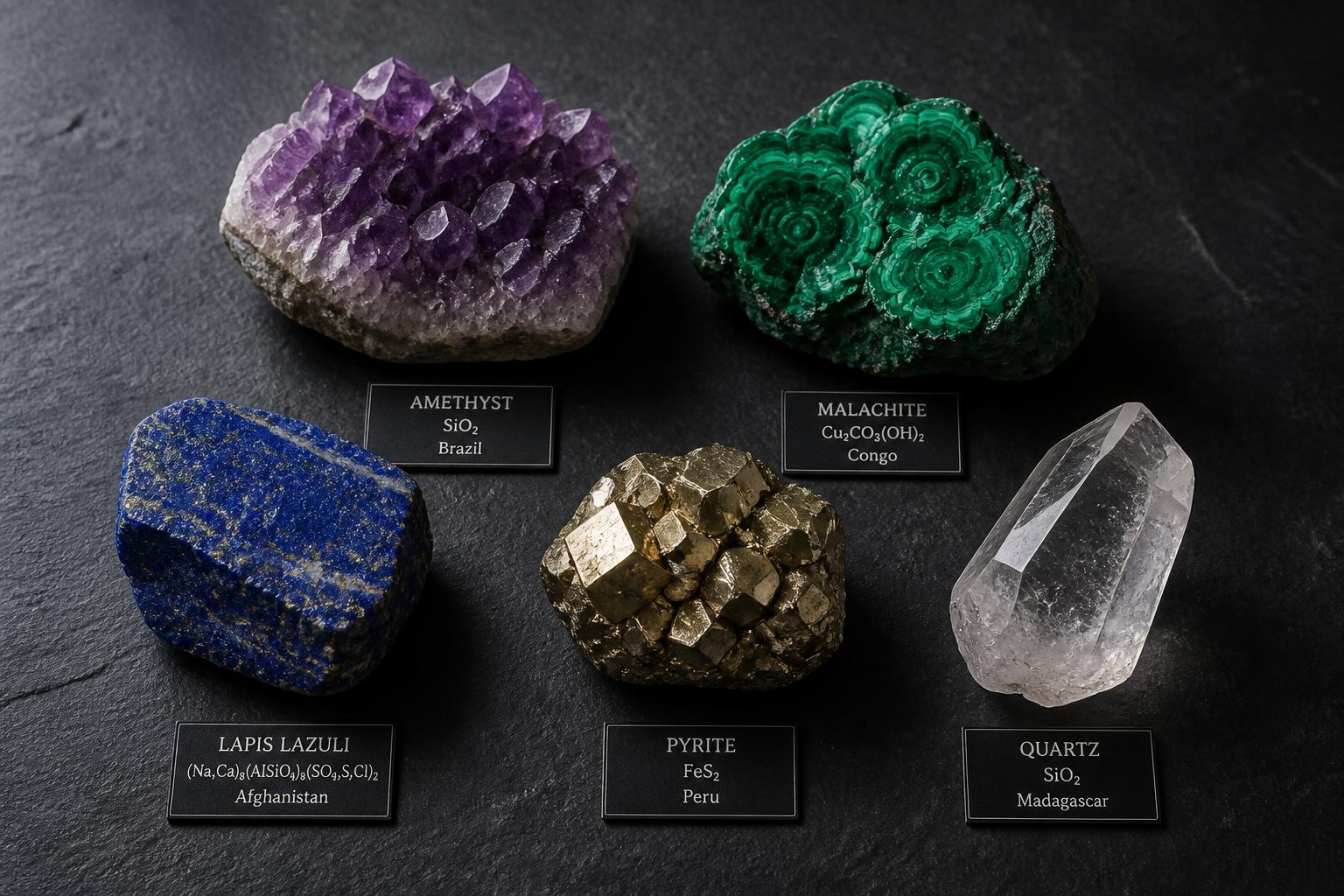
Crystals genuinely interact with pressure, light, electricity and magnetism. Humans genuinely attach emotion and symbolism to colour. The difficult question is what happens when measurable material properties become claims about an invisible human field.
Begin with the stone itself
Minerals do not need mystical claims to be extraordinary.
A crystal is matter arranged with long-range structural order. Atomic patterns repeat through three-dimensional space. That invisible lattice determines macroscopic properties: cleavage, hardness, optical behaviour and symmetry.
Quartz can generate electrical charge under mechanical stress through piezoelectricity. Magnetite interacts strongly with magnetic fields. Calcite splits light into two rays. Some minerals fluoresce under ultraviolet radiation. Others change colour depending on impurities or crystal defects.
These are not metaphors. They are measurable properties.
The confusion begins when the word "energy" moves from physics into spiritual language without announcing the change of definition.
What physicists mean by field
Physics uses the concept of a field very precisely. Electric, magnetic and gravitational fields describe quantities distributed through space and can be measured or modelled. The human body also generates measurable electrical and magnetic activity. The electrocardiogram records electrical activity associated with the heart. The electroencephalogram records voltage changes associated with brain activity. Magnetocardiography and magnetoencephalography can detect extremely weak magnetic fields produced by physiological currents.
So saying "the human body has electromagnetic activity" is uncontroversial.
Saying "a crystal balances the human energy field" is a different claim. It requires a defined field, a measurable change and a reproducible mechanism linking the mineral to the outcome.
The words sound related. The evidence may not be.
Quartz: the perfect bridge between science and myth
Quartz is central to modern technology. Its piezoelectric behaviour allows carefully manufactured quartz resonators to stabilise oscillator frequencies. Quartz appears in watches, electronics, sensors and optical systems.
This technical reality makes spiritual claims about quartz feel intuitively plausible. If quartz can control frequency in a circuit, perhaps it can "tune" a person.
But a quartz watch works because engineers construct an electrical circuit around a crystal cut to specific dimensions and orientations. The crystal is driven, measured and connected.
A loose crystal held in a hand does not automatically reproduce that engineered system.
Still, holding a crystal may affect a person through other pathways: touch, expectation, ritual meaning, attention, memory, aesthetics or placebo/context effects. Those pathways are psychologically real even when a proposed electromagnetic mechanism is unsupported.
Colour: physics becomes experience
Colour begins with light but ends in perception.
Minerals absorb, transmit and scatter wavelengths depending on electronic structure, impurities and defects. Lapis lazuli, malachite, amethyst and turquoise became culturally powerful partly because their colours were rare, stable or visually striking.
A 2025 systematic review covering 132 studies and more than 42,000 participants across 64 countries found systematic associations between colours and emotions. Lightness, saturation and hue all contributed. The researchers also cautioned that association does not automatically mean a colour will cause the corresponding emotion in every real-world context.
This nuance is exactly what we need.
Colour can carry reliable psychological meaning without being a universal medical treatment.
Lapis lazuli: a stone that travelled farther than its symbolism
Lapis lazuli was prized in the ancient Near East and Egypt. Its intense blue connected material rarity with status, divine imagery and celestial associations. Long-distance trade brought lapis from sources in Central Asia into ancient cultural centres far away.
When a material is difficult to obtain, its symbolic value can grow alongside its economic value.
A sacred stone may therefore have several "energies" in ordinary language: visual intensity, social prestige, emotional association, ritual importance and actual physical properties.
Those meanings can coexist without being the same phenomenon.
Magnetite and the invisible
Magnetite provides perhaps the best historical example of a mineral whose real invisible force invited larger speculation. Lodestone can attract iron and align with Earth's magnetic field. Before modern field theory, this behaviour seemed almost animate.
Renaissance natural philosophers debated magnetism alongside other hidden qualities of matter. Eventually, careful experiment turned a mysterious attraction into a foundation of physics.
This history should make both sceptics and believers humble.
Some invisible effects are real before they are understood. But not every claimed invisible effect becomes real simply because magnetism once seemed mysterious.
What about biofield research?
"Biofield" is used in complementary-medicine literature as a proposed framework for energy or informational interactions associated with living systems. Clinical studies of practices such as Reiki, Therapeutic Touch and related approaches exist, but reviews repeatedly note heterogeneity, methodological limitations and uncertainty about mechanisms. A 2025 evidence map found hundreds of studies but concluded that inconsistent reporting and variable results still limit firm conclusions for specific conditions.
Importantly, clinical outcome research does not by itself establish the existence of a particular external field or show that minerals manipulate it.
Mechanism and outcome are separate scientific questions.
A better crystal experiment
If we wanted to test whether crystals exert effects beyond expectation, the study should be blinded and controlled.
Participants could handle visually concealed objects of matched weight and temperature: quartz, glass and another mineral. Neither participant nor immediate experimenter would know which was which. Researchers could measure subjective sensations, autonomic variables and any proposed electromagnetic changes.
If quartz consistently produced a distinct effect under blinded conditions, that would justify further work. If expectations predicted the effect better than material, that would also be informative.
Either result tells us something about humans and objects.
Why stones become personal
A stone can be a memory anchor. Jewellery can carry a relationship. A colour can become associated with grief or safety. A crystal chosen during a difficult period can become a tactile ritual cue that helps a person pause, breathe or focus.
Calling that "just psychological" misunderstands psychology. Meaning changes attention and behaviour.
But respecting symbolic experience does not require pretending that every subjective effect has already been demonstrated as a new force of nature.
Matter and meaning
The most interesting story of crystals is therefore not science versus spirituality.
It is how humans encounter structured matter and build layers of meaning around it.
At the bottom: atoms, lattices, defects, light, charge.
Above that: colour, texture and sensory response.
Above that: rarity, trade, memory, ritual and myth.
Above that: claims about invisible fields, some testable, some currently undefined.
Confusion occurs when one layer is used as proof for another.
Closing thoughtA crystal can be physically remarkable, psychologically meaningful and spiritually important to someone without those three statements being interchangeable. Perhaps the most respectful approach to mystery is to let each layer remain precise enough to be truly explored.
— Madame Monsieur