The Monolith Effect — When an Object Says Nothing and Everyone Hears Something
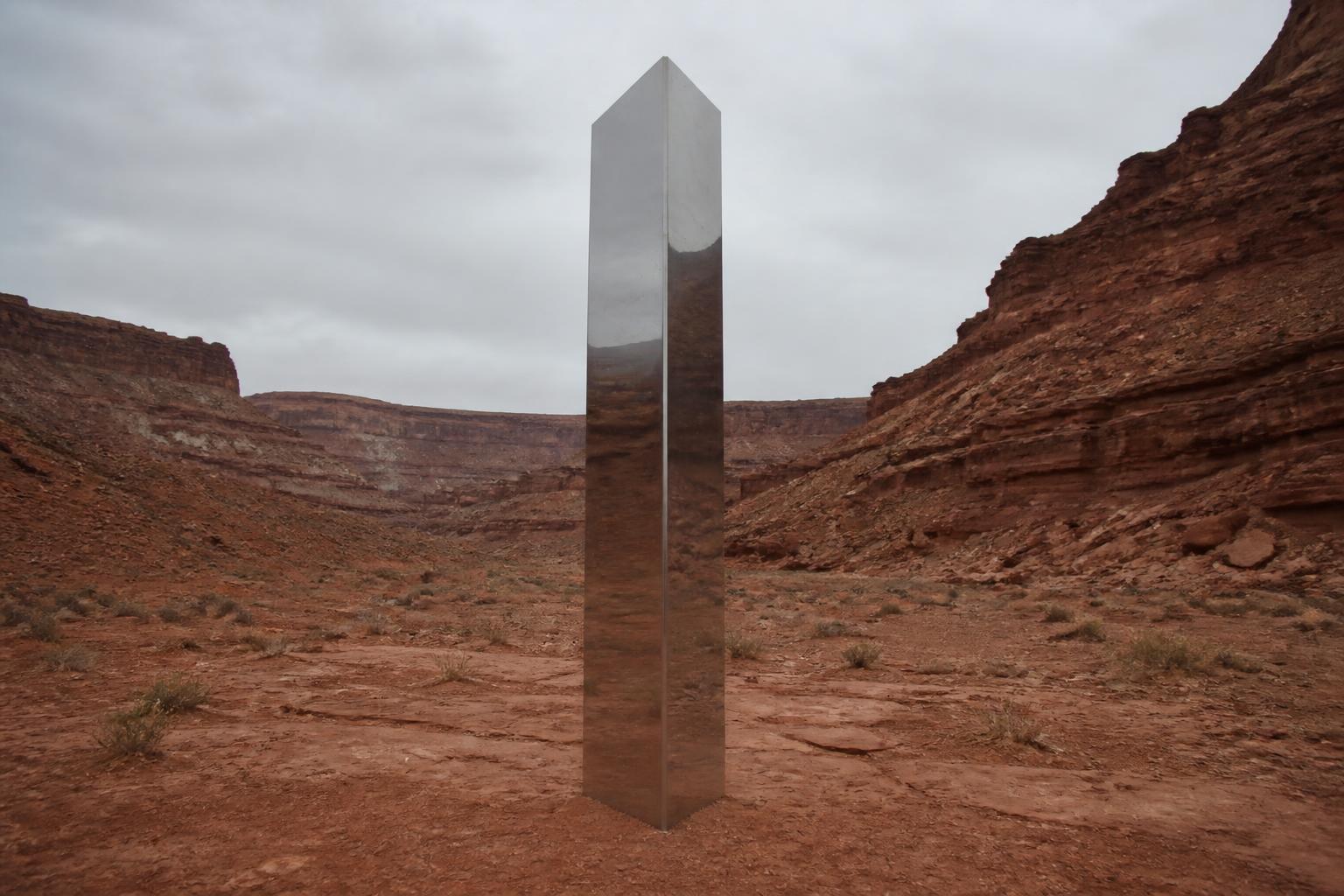
A three-metre metal object stood silently in the Utah desert for years. Once humans noticed it, the silence became a global message.
The discovery that was not the beginning
On 18 November 2020, a helicopter crew surveying bighorn sheep in Utah noticed a metallic object standing in a remote red-rock landscape. Photographs spread quickly. It looked uncannily clean against the desert: tall, narrow, geometric, silent.
The internet treated the discovery as an arrival.
Satellite imagery complicated the story. The object appears to have been installed years earlier, probably around 2016. That means the most famous monolith of 2020 may have stood unnoticed for roughly four years. Its cultural life did not begin when it was erected. It began when it was seen.
This distinction is the heart of the Monolith Effect.
It was not actually a monolith
In the strict sense, a monolith is a single block of stone or material. The Utah object was a fabricated hollow structure made from sheet metal panels attached with rivets around an internal framework. It was roughly three metres tall and had a triangular cross-section.
After its removal, observers could see that it had been installed deliberately rather than dropped from nowhere. Reports and photographs indicated that the rock at its base had been cut or altered to seat the structure. The exact installation depth is less securely documented than the dramatic images suggest, so it should not be invented after the fact.
Its construction was humanly achievable. That does not answer who made it or why they left no signature.
The power of no text
The Utah monolith carried no obvious inscription explaining itself. There was no artist statement attached to the desert. No date. No logo. No title.
This absence behaved like an amplifier.
If the object had read "Sculpture No. 4, 2016," most of its mythology would have collapsed instantly. Because it said nothing, observers supplied everything: alien marker, portal, film reference, conceptual art, prank, beacon, warning, experiment.
In semiotics, meaning is not contained only in an object. Meaning arises in relationships among object, context and interpreter. The monolith turned this into a worldwide live demonstration.
Why 2001: A Space Odyssey appeared immediately
Stanley Kubrick's 1968 film *2001: A Space Odyssey*, based with Arthur C. Clarke's work, gave modern culture one of its strongest monolith images: an immaculate geometric object associated with intelligence, transformation and evolutionary thresholds.
The Utah object did not need to copy the fictional monolith exactly. It only had to be close enough to activate cultural memory.
This is how symbols work. A rectangle can become more than geometry when a society has already stored a story inside that shape.
Then the copies appeared
Within days of the Utah object becoming global news, monolith-like structures appeared in Romania, California, the United Kingdom and elsewhere. Their materials and workmanship varied. Some were mirrored. Some were crudely welded. Some stood on wooden supports. Some carried surface patterns. Several makers eventually claimed responsibility for individual examples.
The differences matter. They argue against treating every monolith as the output of a single hidden technology or organisation.
But as a cultural event, their lack of uniformity is almost more interesting. Once the visual grammar was established — tall, metallic, geometric, unexplained — anyone could speak it.
The monolith became a meme made physical.
Romania and the temptation of pattern
The Romanian example, reported near the archaeological area of Batca Doamnei, differed from Utah. Its surface carried repeated circular or looping marks and its construction appeared less refined. Because it stood near an ancient site, observers immediately searched for alignments and historical symbolism.
This is exactly where caution becomes productive rather than restrictive.
A location near archaeology is not automatically an archaeological connection. A repeated mark is not automatically writing. An orientation toward a mountain is not meaningful unless deliberately measured and compared against plausible alternatives.
The correct response is not "nothing to see." It is "measure before interpreting."
Did the environment change?
One of the most intriguing questions is also one of the least documented: did anything measurable change around the original Utah site before or during the discovery?
There is no strong evidence in the public record for unusual radiation, magnetic anomalies, seismic events or biological effects caused by the object. The most obvious environmental change came after humans arrived. Crowds drove into fragile desert terrain, created tracks and waste, and transformed an isolated site into a destination. The Bureau of Land Management urged visitors not to damage the landscape.
The measurable anomaly, in other words, may have been social.
Why November 2020 mattered
The object became famous during the COVID-19 pandemic, when much of the world was living through restriction, anxiety and relentless news. A mysterious object in a desert created something rare: a global story that was strange without being immediately tragic.
The timing does not explain who built the original. It helps explain why the world was ready to play with it.
Mysteries do not spread only because they are mysterious. They spread because they arrive when a culture has room — or need — for a particular kind of story.
Was the first object an experiment?
Consider an unusual possibility that does not require aliens or secret technology.
What if the creator wanted no immediate audience?
Installing an object in a remote place and leaving it for years is a peculiar strategy for ordinary publicity. Perhaps it was private art. Perhaps its location had personal meaning. Perhaps discovery was always intended, but only eventually. Perhaps the maker underestimated how long it would remain unseen.
Or perhaps the lack of authorship was the work.
If so, the experiment succeeded spectacularly. Once the object was found, millions of people projected stories onto a blank surface.
The real monolith may be the human response
The most revealing part of the phenomenon is not the metal.
It is the speed at which we became uncomfortable with an unexplained object.
We wanted provenance. We wanted motive. We wanted a maker. Where those were absent, we produced narrative. This tendency is not a flaw unique to conspiracy culture. It is a basic feature of human cognition. Pattern detection, causal inference and storytelling help us survive. The same abilities can also make uncertainty feel intolerable.
The monolith gave those mechanisms almost nothing to work with — and that was enough.
Closing thoughtWe may eventually identify every tool mark and every person involved in the Utah monolith. But even then, its deepest lesson would remain. Give humanity a shape, a silence and an unanswered question, and we will build a world around it.
— Madame Monsieur