The Phaistos Disc — 241 Symbols and No Certain Translation
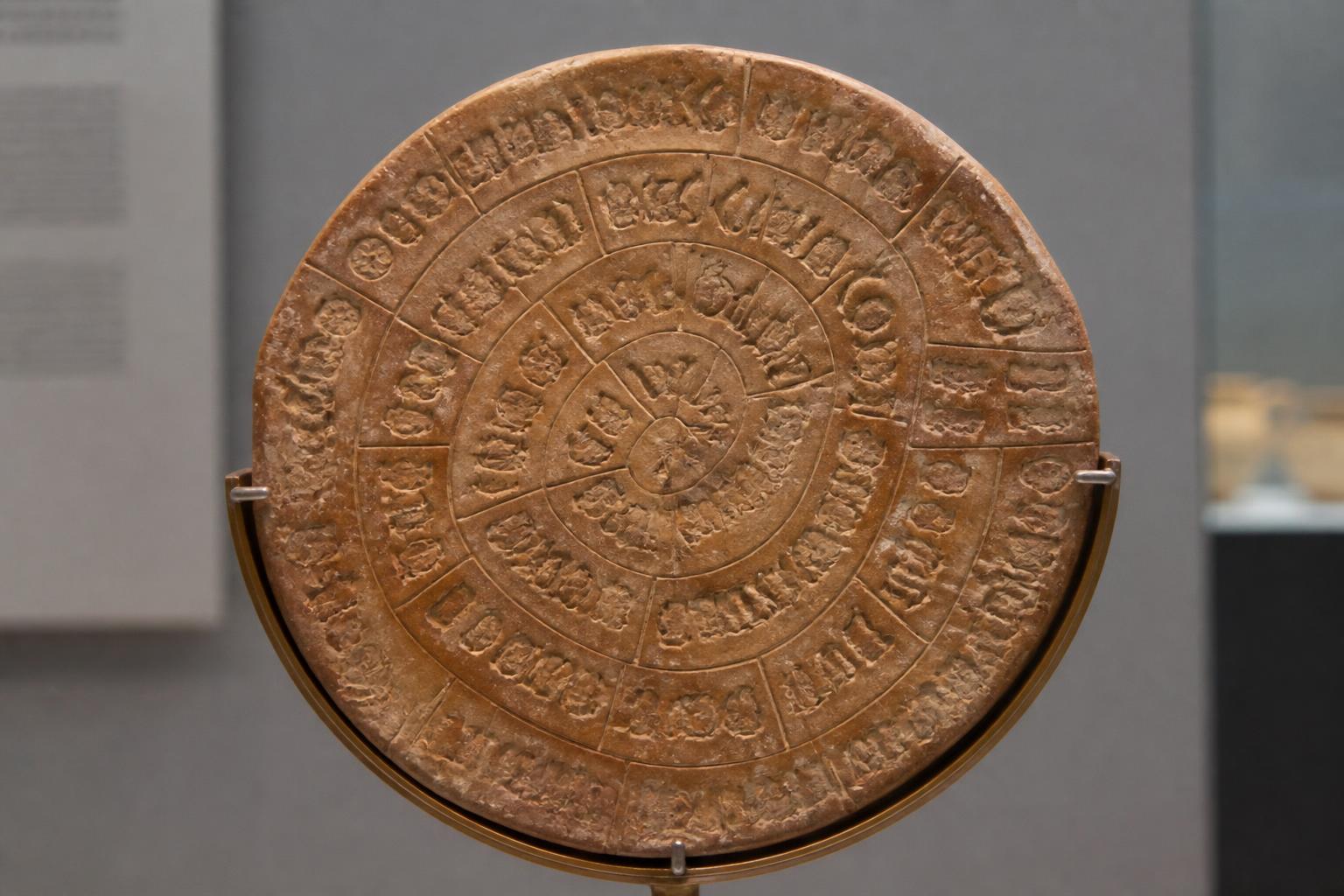
A fired clay disc from Bronze Age Crete carries 241 impressed signs arranged in a spiral. We know where it was found. We can see every mark. We still cannot agree on what it says.
A message pressed into wet clay
On 3 July 1908, Italian archaeologist Luigi Pernier discovered a clay disc in the palace complex at Phaistos on Crete. The object was already unusual. Its signs had not simply been scratched by hand. Many appear to have been impressed into the wet clay using individual stamps before the disc was fired.
Both sides carry a spiral sequence divided into groups. The Heraklion Archaeological Museum counts 241 signs arranged in 61 groups.
The disc therefore looks like text. It has repetition, boundaries and direction.
But unlike the Rosetta Stone, it offers no bilingual key. Unlike Linear B, it lacks a large corpus of comparable documents. It is almost alone.
The curse of a unique object
Decipherment depends on repetition. If hundreds of tablets use the same signs in administrative contexts, scholars can compare names, formulas, quantities and grammatical patterns. With one short text, almost any proposed translation can be made to fit if enough assumptions are allowed.
This is the central problem of the Phaistos Disc.
We can count signs. We can identify repeated sequences. We can compare possible relationships to Cretan Hieroglyphic, Linear A and other Aegean scripts. But a small corpus creates an enormous space of possible solutions.
A decipherment is not proven because it produces meaningful words. Human ingenuity can produce meaningful words from surprisingly weak constraints.
Printed before printing?
The stamped signs have inspired claims that the disc represents an early form of movable-type printing. In the narrow sense, reusable stamps were apparently employed. That is technologically interesting.
But comparing the object directly to Gutenberg can mislead. A single stamped inscription does not demonstrate a publishing system, mass reproduction or an industry of interchangeable type.
Still, the manufacturing choice is significant. Why create separate stamps rather than incise every symbol? Perhaps the maker expected repeated use. Perhaps the signs were part of a broader craft tradition that has not survived. Perhaps the technique was experimental.
One object can hint at a technology without revealing its scale.
What do the signs depict?
The pictograms include human figures, heads, birds, plants, tools, vessels and other forms. Because some signs look representational, they tempt us to read them semantically: a ship must mean ship, a head must mean person, a plant must mean plant.
But writing systems often detach signs from pictures. The letter A does not mean ox today even though its deep ancestry may connect to an ox-head form. Egyptian hieroglyphs could function as sound signs, words or classifiers depending on context.
A picture of a head might therefore represent a sound rather than a head.
This is why visual intuition alone cannot decipher the disc.
Hymn, inventory, prayer or game?
Repeated groups have been interpreted as refrains, which has encouraged proposals that the text is a hymn, prayer or incantation. Others have proposed administrative, calendrical or even game-related meanings.
The museum itself notes that repetition has been taken as evidence for a hymn or incantation, but experts have not reached a definitive conclusion.
That uncertainty should be preserved rather than treated as failure.
An undeciphered object is not an empty object. We can still study its material, manufacture, archaeological context and structure.
Authenticity debates
Because the disc is so unique, some scholars and commentators have questioned whether it could be a modern forgery. Most discussions of the object, however, treat it as a genuine archaeological find from the Phaistos excavation. The ideal way to reduce remaining doubts would be to apply every appropriate non-destructive analytical method and publish results transparently.
Science does not weaken a mystery by testing authenticity. It protects the mystery from being built on the wrong object.
Why one missing key matters
The Phaistos Disc demonstrates the fragility of cultural memory. Imagine a civilisation produces thousands of texts, but almost all are destroyed by fire, water, decay, reuse and conquest. One object survives.
To us, that civilisation can appear mute even if it was once saturated with writing.
Meaning is not preserved by one inscription alone. A language survives through communities, repeated documents and teaching traditions.
This is why undeciphered scripts feel haunting. The marks survived the people who knew how to hear them.
Could a future discovery solve it?
Absolutely.
A second disc, a long inscription in the same script, a bilingual text or an inscription paired with known names could transform the problem overnight. Linear B seemed mysterious until sufficient evidence and brilliant comparative work allowed Michael Ventris and others to demonstrate that it encoded an early form of Greek.
The Phaistos Disc may be waiting not for a genius but for another object.
Archaeology often advances because the ground provides one more sentence.
Closing thoughtThe disc has not failed to speak. We have failed to inherit the listening system. Somewhere between those 241 signs and our eyes lies a missing community of readers.
— Madame Monsieur