The Philosopher's Stone — Substance, Symbol or Transformation?
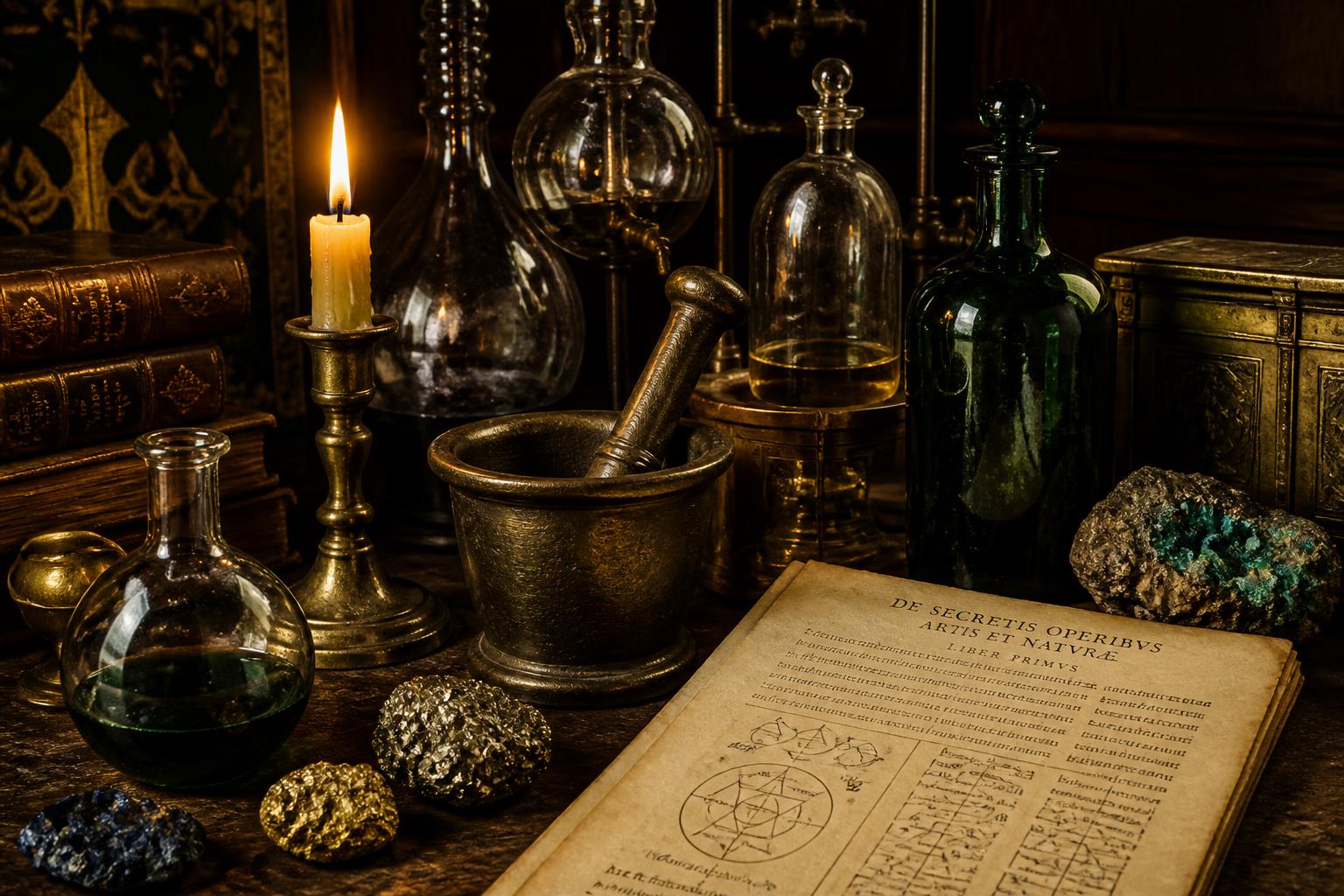
For centuries, serious experimenters searched for a substance that could perfect matter, transform metals and perhaps prolong life. The Philosopher's Stone became both laboratory goal and metaphor for human transformation.
The stone that was not necessarily a stone
The Philosopher's Stone sounds like a magical jewel. In alchemical literature, however, the word "stone" could refer to a prepared substance, powder, tincture or perfected material rather than an ordinary mineral picked from the ground.
Its legendary powers varied across texts. Most famously, it was supposed to transform base metals into gold or silver. In some traditions it also belonged to the search for an elixir capable of improving health or extending life.
Modern readers often treat these goals as obvious nonsense. That misses the intellectual environment in which alchemy developed.
For an early chemist watching metals change colour in a furnace, ores yield shining metal, salts crystallise from invisible solution and mercury form alloys, matter appeared astonishingly transformable. If nature could turn raw substances into metals beneath the Earth, why should a skilled practitioner not learn to accelerate or perfect that process?
Alchemy was not one thing
Alchemy developed across Greek, Egyptian, Arabic, Persian and European intellectual worlds. It combined practical operations with theories of matter, medicine, cosmology, philosophy and theology. Recipes could sit beside allegory. Laboratory observations could be encoded in mythic language. Authors borrowed authority from famous names, sometimes pseudonymously.
The Arabic-language alchemical tradition profoundly influenced medieval Europe through translation. Later European experimenters, including figures associated with the Scientific Revolution, continued to engage with alchemical questions. Isaac Newton's private alchemical work is now well documented.
So the history is not "magic ended and science began." The boundary was gradual and messy. Techniques associated with alchemical practice contributed to the development of laboratory culture, materials knowledge, distillation, metallurgy and pharmacy.
Why gold?
Gold represented more than wealth. It resists corrosion, maintains lustre and was often treated as the most perfect metal. If metals differed by degrees of perfection rather than by fundamentally different atomic identities — a concept not yet available — then transmutation could appear plausible.
The Philosopher's Stone was imagined as a powerful agent of perfection. A tiny amount might transform a larger mass, just as yeast transforms dough or a catalyst changes a reaction without being consumed in the same way as ordinary reagents.
This analogy helped make the idea intellectually resilient.
The coded language of the Great Work
Alchemical texts are famous for dragons, kings, queens, suns, moons, marriages, deaths and rebirths. Some imagery concealed procedures. Some organised theories. Some expressed spiritual meaning. Some may have protected commercial secrets.
The Great Work, or *magnum opus*, later became associated with stages such as blackening, whitening, yellowing and reddening. Modern esoteric interpretations often read these as a map of psychological transformation.
Historically, caution is needed: not every alchemist understood the stages in the same way, and Jungian psychological interpretations are much later than medieval laboratory practice.
Yet the metaphor works because alchemy already linked purification of matter with ideas of perfection.
Did anyone ever make gold?
Not by chemical alchemy. Modern chemistry tells us that one chemical element cannot be converted into another by rearranging electrons or mixing reagents. Gold is defined by its atomic nucleus: 79 protons. Changing another element into gold requires nuclear processes, not an alchemical furnace.
Ironically, nuclear physics has made artificial transmutation real in principle. Elements can be transformed through nuclear reactions. Producing useful quantities of gold this way is economically absurd, but the conceptual dream — one element becoming another — is not forbidden by nature. It simply operates through mechanisms alchemists could not know.
This is one of history's delicious reversals: the goal was wrong in method, but "elements can never change" would also have been wrong.
The search produced discoveries anyway
The pursuit of impossible or mistaken goals can generate real knowledge. In 1669, Hennig Brand isolated phosphorus while working in an alchemical context and seeking transformative secrets. Early modern experimenters refined methods of heating, separating, dissolving and crystallising substances.
The Philosopher's Stone therefore functioned as a research attractor. It gave practitioners a reason to perform difficult experiments repeatedly.
This does not validate the stone. It shows that wrong theories can still create useful observations.
From material stone to psychological stone
In modern spiritual and psychological language, the Philosopher's Stone is often treated as a symbol of integration: turning the "base" material of ordinary consciousness into a more coherent self. Carl Jung found alchemical imagery especially useful as a symbolic parallel to processes of individuation.
This interpretation should not be projected backward as the single hidden purpose of all alchemy. Many historical alchemists genuinely wanted material transmutation.
But symbols can outlive original intentions. Once the literal laboratory project declined, the image of transformation remained.
Lead becomes gold. Confusion becomes order. Fragmentation becomes integration. Death becomes renewal.
The metaphor is almost too powerful to disappear.
Was the stone ever one secret recipe?
Probably not in the way popular legend imagines. Alchemical traditions were diverse, and recipes attributed to the stone vary dramatically. Mercury, sulfur and salts appear frequently in different theoretical systems. Texts often contradict one another.
The very absence of a reproducible recipe helped sustain the legend. Failure could be explained by wrong materials, wrong timing, insufficient purification, a missing secret or spiritual unworthiness.
A claim that cannot be cleanly falsified can survive for centuries.
The philosophical stone that actually existed
There is another way to read the story without reducing it to either fraud or enlightenment.
The Stone represents a recurring human conviction: **matter contains possibilities we do not yet understand, and transformation can be learned.**
That conviction drove alchemists into laboratories. It also survives in modern science. We now engineer materials atom by atom, manipulate genes, grow crystals, build metamaterials and convert mass into energy under extreme conditions.
The difference is not curiosity. It is method.
Closing thoughtThe Philosopher's Stone was never demonstrated as the miraculous substance alchemists sought. But the search left behind something real: a laboratory tradition built around the dangerous and productive idea that nature might reveal more possibilities when matter is persuaded to change.
— Madame Monsieur