The Sacred Botanical Code of Ancient Egypt — Plants, Symbols and Survival
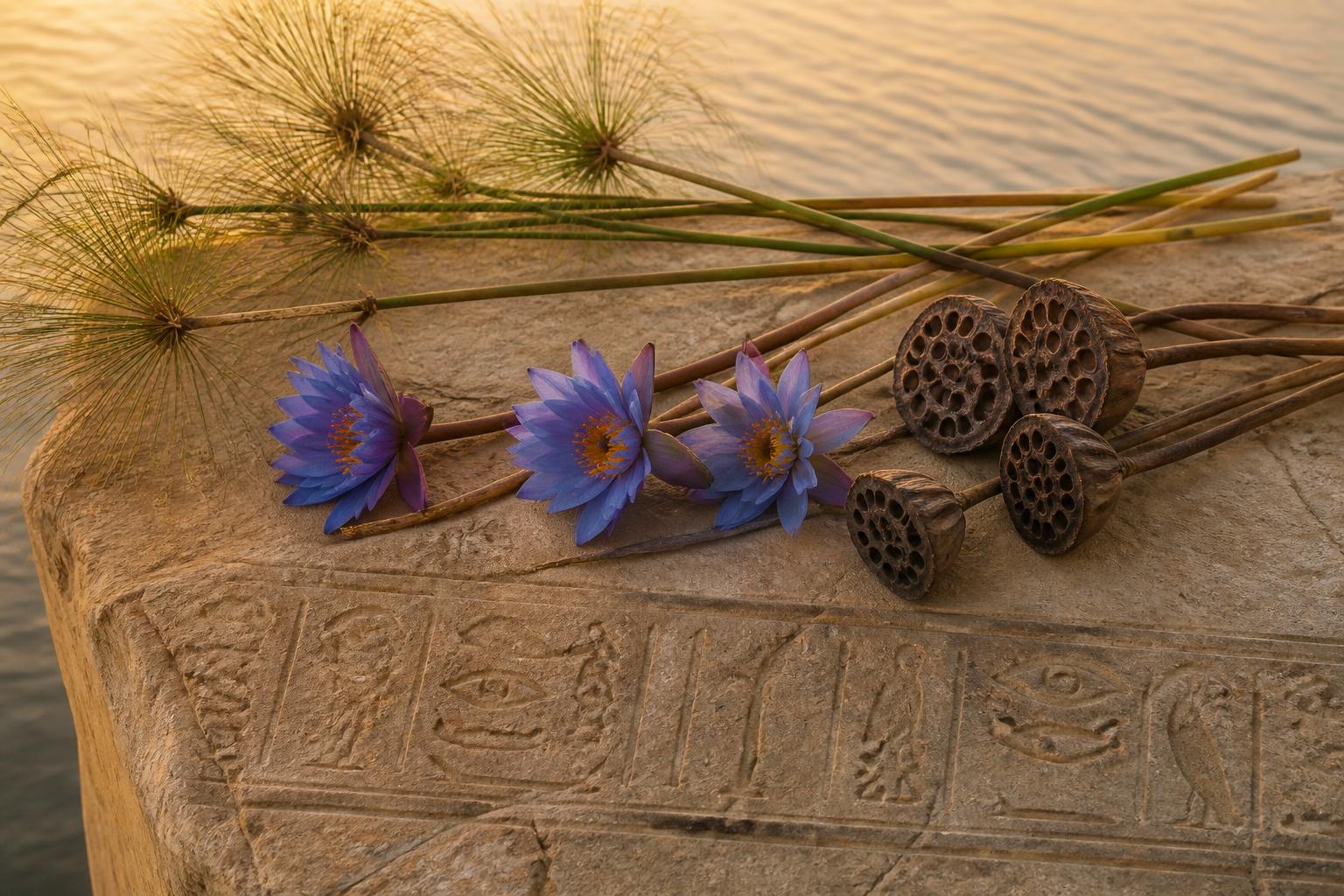
In ancient Egypt, plants were food, medicine, building material, perfume and writing surface - but they were also symbols. The Nile landscape became a vocabulary of rebirth, kingship, protection and creation.
A civilisation written partly in plants
Ancient Egyptian art is filled with vegetation. Blue water lilies open above painted pools. Papyrus stalks rise into architectural columns. Date palms frame gardens. Grapes hang from painted vines. Mandrake fruits appear in floral scenes. Trees shelter deities and the dead.
To treat these plants as decoration alone is to miss how closely the Egyptian symbolic world grew from the Nile environment.
The landscape supplied materials for daily life and images for cosmic thought. Flood, germination, flowering, shade, fragrance and seasonal return became natural metaphors for continuity and rebirth.
Botany and symbolism were never far apart.
The "blue lotus" that is actually a water lily
One of the most recognisable Egyptian flowers is commonly called the blue lotus. Botanically it is the blue water lily, *Nymphaea caerulea*.
Its daily rhythm made it symbolically powerful. The flower closes and opens in relation to the light cycle, and Egyptian imagery connected it with the sun, renewal and rebirth. The Metropolitan Museum notes this association explicitly in objects where blue water lilies alternate with papyrus.
The distinction between lotus and water lily matters because modern spiritual culture often builds claims on the romantic name while forgetting the plant itself.
The real biology is already beautiful enough: a flower emerging from water, responding to daylight and becoming an image of return.
Papyrus: plant, writing surface and kingdom
Papyrus was both practical infrastructure and political symbol.
The plant thrived in marshy environments and could grow several metres tall. Egyptians used it for writing material and many other products. Symbolically, papyrus represented Lower Egypt. The water lily represented Upper Egypt. Images of the two plants bound together expressed the union of the Two Lands.
The hieroglyphic and artistic life of papyrus went further. Papyrus columns turned stone architecture into an idealised marsh. Temple space could evoke the primeval landscape associated with creation.
Architecture imitated botany because botany already contained cosmology.
The marsh as beginning
Egyptian creation traditions repeatedly imagine emergence from primordial waters. The annual Nile inundation provided a visible model: water covers land, then fertile ground reappears and vegetation returns.
A papyrus thicket was therefore not merely habitat. It could evoke fertility, concealment, birth and the first landscape.
This is a key principle of ancient symbolism: the symbol often works because the natural process is observable.
Rebirth is persuasive when the landscape itself appears to die and return.
Acacia: survival at the edge
Acacia species adapted to arid environments offered hard wood, shade, thorns, gum and strong visual presence in dry landscapes. Acacia also entered Egyptian religious and funerary symbolism in varied contexts.
Modern writing sometimes assigns one fixed meaning — "tree of life" — to every ancient appearance. The record is more complex. Tree symbolism depended on species, deity, text and period.
What remains compelling is the ecological logic. A tree that remains alive where water is scarce easily becomes associated with persistence.
Symbolism often begins as close observation.
Mandrake: the human-looking root and fragrant fruit
Mandrake became one of the most mythologised plants of the ancient Mediterranean and Near East. Later European folklore focused on its forked root, which can resemble a human form, and invented stories about screams, magic and dangerous harvesting.
In Egyptian contexts, mandrake fruits appear in art and have been discussed in relation to fragrance, sexuality, festivity and medicinal or intoxicating traditions.
Care is needed because popular descriptions often exaggerate psychoactive claims. Mandrake contains tropane alkaloids that can be toxic and pharmacologically active. That real chemistry may have contributed to the plant's later reputation, but ancient use cannot be reconstructed simply by applying modern pharmacology backward.
The plant sits at the boundary between symbol and substance.
Date palm: time, abundance and human cultivation
Date palms offered food, shade and economically valuable material. Palms also became visual markers of abundance and ordered cultivation in a landscape where irrigation meant survival.
In some ancient Near Eastern traditions, stylised tree imagery became entangled with kingship, fertility and sacred order. Egyptian meanings varied, but palms could participate in ideas of longevity and time.
This is another reminder that "sacred plant" does not mean a plant separated from ordinary life. The sacred often intensifies what is already necessary.
Frankincense and myrrh: sacred plants arriving from elsewhere
Resins such as frankincense and myrrh connected Egypt to long-distance trade networks. Their fragrance transformed ritual space through smoke and scent. Expeditions and trade brought valued aromatics from regions to the south and east.
Smell is neurologically powerful because olfaction is closely tied to memory and emotion. Ancient ritual did not need a neuroscience vocabulary to know that scent changes a room.
A resin could therefore be economic commodity, medicine, perfume and sacred offering at once.
Plants as technology
The phrase "sacred botany" can make plants sound purely symbolic. In reality, plants were technologies.
Papyrus stored information. Flax became linen. Wood became boats and furniture. Resins preserved, perfumed and sealed. Oils carried scent. Fibres became ropes. Dyes transformed cloth. Food crops stabilised populations.
The symbolic world grew beside this practical intimacy.
People gave meaning to plants because plants were already shaping life.
Did plants encode a secret language?
Egyptian art certainly used plants conventionally. A papyrus could signal Lower Egypt. A water lily could evoke rebirth. Floral combinations could express political unity or divine associations.
But the phrase "botanical code" should be used poetically, not as a claim that every painted bouquet encrypts a hidden message readable through one universal key.
Context remains essential. Tomb art, temple architecture, household objects and medical texts use plants differently.
A code with no context becomes projection.
Survival beyond civilisation
Perhaps the most moving feature of Egyptian plant symbolism is that many of the organisms themselves still exist.
Empires change. Scripts become unreadable. Temples erode. A water lily still opens to morning light. Papyrus still produces its umbrella-like crown. Acacia still survives heat and drought.
The biological process outlives the interpretation.
This gives ancient symbolism an unusual bridge into the present. We cannot interview an Egyptian priest, but we can observe the same kind of flower that made rebirth visually persuasive thousands of years ago.
Nature as the first symbolic teacher
Before humans had philosophical vocabulary for cycles, plants displayed cycles. Before metaphors of death and return were written, seeds disappeared into soil and emerged transformed. Before diagrams of branching systems, trees branched.
Ancient cultures did not invent meaning from nothing. They watched living systems and used them to think.
That may be why plant symbols remain understandable even after the original theology fades.
Closing thoughtPerhaps the sacred botanical code of Egypt was never hidden. It was growing in full view - in water, mud, scent, seed and sunlight - waiting for humans to recognise their own questions inside the life of plants.
— Madame Monsieur