Shapes, Sound and the Human Mind — Can Form Change How We Feel?
A sharp shape can feel louder than a round one. A low tone can feel larger than a high tone. Architecture, language and music all exploit cross-sensory relationships the brain often notices before we do.
We do not experience the senses separately
Textbooks divide perception into sight, hearing, touch, taste and smell because categories make biology easier to teach. The lived brain does not maintain such neat borders.
A high-pitched sound can feel small or bright. A low sound can feel heavy or large. A rough texture can influence how a taste is described. A visual rhythm can make music feel faster. Rounded and angular shapes can seem to "belong" with different speech sounds.
Researchers call many of these tendencies cross-modal correspondences.
They do not require synaesthesia. They appear, to varying degrees, in ordinary perception.
Bouba and kiki
The most famous example presents two meaningless words and two shapes. One shape is rounded, the other spiky. Many participants pair "bouba" with the rounded form and "kiki" with the angular one.
The effect has been studied in different languages, age groups and sensory conditions. Explanations include acoustic properties, mouth movements, statistical learning and broader perceptual dimensions such as arousal.
A 2025 review of sound-symbolism research and a 2026 experiment on drawing responses continue to show that consonant and vowel properties can influence perceived or produced shape.
The result is modest but philosophically significant: the relation between sound and meaning is not always entirely arbitrary.
Why an angle can feel sharp even when it cannot cut
Words such as "sharp" already demonstrate sensory borrowing. A knife can be sharp. So can a sound, colour, taste or mind.
This linguistic flexibility reflects deeper perceptual organisation. Angular forms often signal edges, collision or threat. Rounded forms often signal softness or continuity. Evolution, learned associations and physical regularities may all contribute.
An angular shape is not objectively aggressive. Context changes perception. But designers know that repeated diagonals, hard contrast and narrow points can create tension, while curves often feel more continuous or organic.
Architecture turns these biases into environments.
Sound changes the body through ordinary mechanisms
Sound is mechanical energy detected by the auditory system, and music can influence attention, emotion, movement and autonomic state. Rhythm can entrain movement. Tempo can affect perceived arousal. Familiar music can evoke autobiographical memory. Repetitive vocalisation can alter breathing simply because vocal production organises exhalation.
These effects are real without needing one universal healing frequency.
Claims that a single frequency such as 432 Hz or 528 Hz has a unique general biological power require much stronger evidence than claims that music, rhythm and acoustic environment affect experience.
The distinction protects fascinating science from being buried under exaggerated certainty.
Cymatics: when sound makes visible patterns
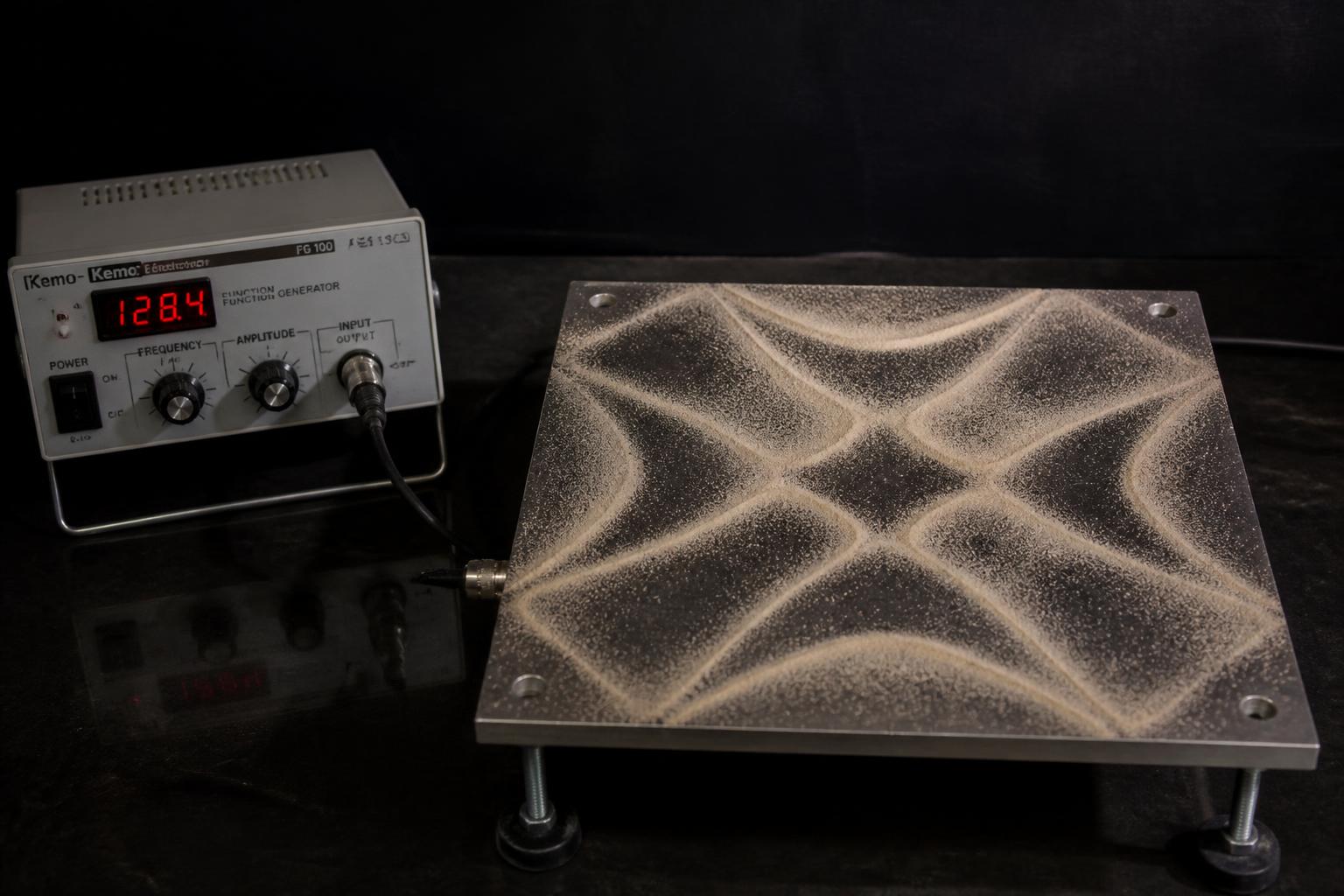
Cymatics refers broadly to visible patterns produced when vibrating plates, membranes or fluids organise particles or surfaces. Chladni figures are a classic example: sand on a vibrating plate gathers along nodal lines where motion is minimal.
The images are spectacular because sound seems to become geometry.
But the pattern depends on the physical system — plate shape, boundary conditions, material, frequency and mode. A particular beautiful figure is not a universal symbol secretly encoded in one frequency.
Cymatics teaches something subtler: **vibration can organise matter when matter is constrained by geometry.**
That principle is powerful enough without mythology.
The room participates
Sound does not exist independently of space. A room filters it. A cathedral stretches voices through reverberation. A carpeted studio absorbs high frequencies. A narrow stone chamber creates strong reflections. A dome can focus sound in surprising ways.
This is why sacred architecture and acoustic experience often become intertwined. Even when a building was not mathematically "tuned," builders and worshippers could discover which spaces made chant, bells or speech more powerful.
The architecture becomes part of the instrument.
This is especially relevant to ancient chambers where ritual and spoken language were important.
Shape changes expectation before contact
Visual form can influence expectation even before an object is touched or heard. Product designers exploit this. A rounded speaker may be expected to sound softer. A jagged logo may imply speed. A heavy block typeface can make a word feel more forceful.
Expectation then alters experience through top-down processing.
This does not mean perception is imaginary. It means perception is predictive. The brain continuously combines incoming information with prior models.
The same object can therefore feel different in a temple, laboratory or nightclub because context changes the model applied to it.
Sacred geometry and the psychological question
Geometric forms have been given symbolic meaning across cultures: circles, squares, triangles, spirals, stars and grids. Some meanings arise from physical structure. A circle has no privileged starting point. A square creates stable orthogonal orientation. A spiral expresses rotation and change in radius.
Other meanings are culturally specific.
The important psychological question is not "Does a triangle emit a universal spiritual frequency?" but "What does repeated exposure to a form do to attention, movement, expectation and meaning?"
That question can be tested.
The future experiment
Imagine a controlled study combining architecture and sound. Participants enter rooms with identical volume and lighting but different geometry: curved, rectilinear, angular. Each room plays acoustically matched tones and speech. Researchers measure subjective emotion, spatial comfort, heart rate, skin conductance and memory.
Then reverse the design: keep shape constant and change reverberation.
Such experiments could help separate visual form from acoustic behaviour and expectation.
The results would matter to architects, therapists, artists and ritual historians alike.
Form as an invisible instruction
Shapes and sounds do not command us like software. They bias attention. They invite movement. They create expectations. They organise sensory information.
That may explain why humans have always surrounded important experiences with deliberate form: circles around fires, columns in temples, rhythmic drums, repeated prayers, patterned textiles, processional paths.
Form tells the body how to enter an experience before language explains what the experience means.
Closing thoughtPerhaps the oldest symbolic systems were powerful not because shapes and sounds contained secret messages, but because the human nervous system was already listening to relationships between them long before we had words for the effect.
Energy, Frequency & Vibration
Where acoustics, neuroscience, and myth listen to the same note.
Enter the project →— Madame Monsieur