The Voynich Manuscript — The Book Nobody Can Read
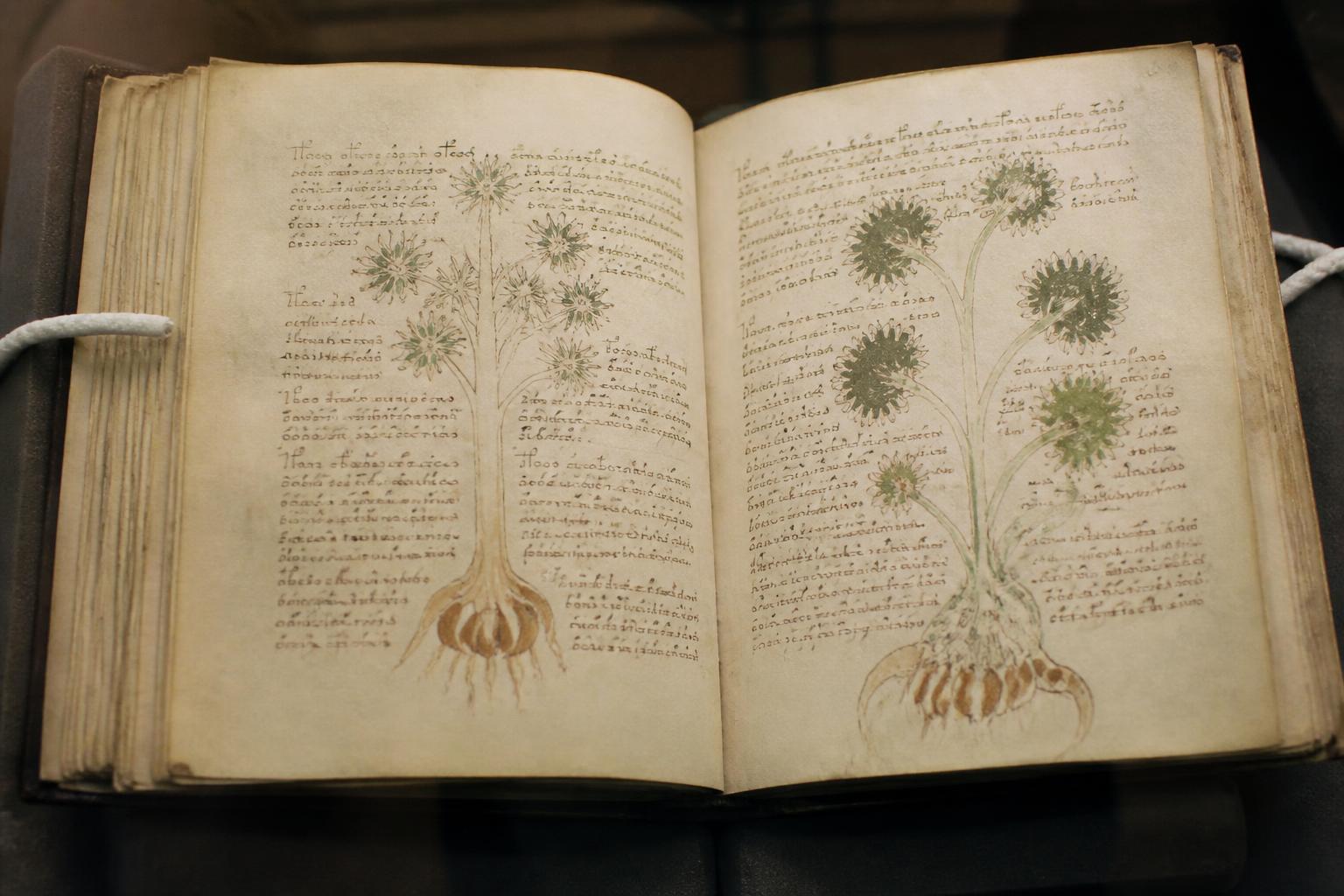
Hundreds of pages. Repeated words. Impossible plants. Astronomical wheels. Bathing figures. A script that behaves like language - and still refuses to explain itself.
A book with all the signs of meaning
The Voynich Manuscript is frustrating because it does not look random.
Its pages contain lines of flowing script divided into word-like units. Some forms repeat frequently. Illustrations appear organised into sections: strange plants, star charts, zodiac-like diagrams, bathing or anatomical scenes, pharmaceutical vessels and text-dense pages marked by star-shaped bullets.
The manuscript appears designed to be read.
We simply cannot read it.
Now preserved as Beinecke MS 408 at Yale University, the codex takes its modern name from Wilfrid Voynich, the Polish-American antiquarian bookseller who acquired it in 1912. Scientific examination places the parchment in the fifteenth century, making the object itself genuinely old even though its language remains unidentified.
Unknown language, cipher or something else?
Several possibilities have competed for more than a century.
Perhaps the text encodes a natural language through substitution or another cipher. Perhaps it records an otherwise unknown or rare language. Perhaps it uses an invented writing system. Perhaps some of the apparent linguistic structure is produced by a generative method rather than meaningful prose.
Each theory solves some features and creates others.
Simple substitution ciphers should be vulnerable to frequency analysis. The manuscript has resisted them. Yet pure random gibberish should not easily reproduce all the statistical patterns researchers have identified in the text.
This tension keeps the problem alive.
The plants that almost exist
The botanical pages are among the most seductive. Many drawings resemble herbal illustrations but do not cleanly match known species. Roots, leaves and flowers seem plausible individually while their combinations become strange.
Some researchers have attempted to identify plants as European, Asian or American species. Others argue that the drawings may be stylised, composite or symbolic.
The danger is visual confirmation bias. Once someone proposes a species, the eye starts finding matching features and ignoring contradictions.
A secure identification would need multiple diagnostic features and ideally textual corroboration. We do not have that.
The astronomical and astrological pages
Circular diagrams include stars, zodiac-like figures and complex radial structures. These pages are one reason the manuscript is often associated with astrology or cosmology.
But an image that resembles a zodiac is not automatically a conventional horoscope. Medieval manuscripts mixed astronomy, astrology, medicine and calendrical systems in ways that do not map neatly onto modern categories.
The manuscript could have been practical, medical, mnemonic, ritual or encyclopaedic — or a hybrid.
Without the text, the illustrations behave like a map whose labels have been erased.
The bathing women
One of the strangest sections shows small nude female figures immersed in green liquid, tubes, pools and interconnected vessels. Modern viewers have compared these images to anatomy, plumbing, alchemy, spas, reproductive systems and symbolic cosmology.
The drawings may depict bathing or balneological practices, a recognised subject in medieval and early modern medicine. But again, certainty is impossible.
What makes the pages powerful is that they look functional. Something is flowing. Something is connected. The viewer feels one explanation away from understanding the system.
That feeling may be exactly why the manuscript is so addictive.
Provenance without interpretation
The manuscript's known history becomes clearer in early modern Europe. It was associated with the court of Emperor Rudolf II, later passed through learned owners, and in 1666 Johannes Marcus Marci sent it to the Jesuit polymath Athanasius Kircher, hoping he might decode it.
Even then, the book was already mysterious.
This is important. The Voynich Manuscript is not merely a modern puzzle created by a bookseller's marketing. Educated readers centuries ago also struggled with it.
Can artificial intelligence solve it?
AI is frequently invoked as the tool that will finally break the manuscript. Machine learning can identify statistical patterns, cluster glyphs, compare scribal variation and test candidate languages at scales difficult for individual researchers.
But AI cannot conjure missing ground truth.
If we do not know the language, encoding method or meaning of the illustrations, a model can generate plausible interpretations that are impossible to verify. A convincing translation is not enough. It must consistently explain the entire corpus, grammar, repeated forms, illustrations and external historical evidence.
The standard of proof should become higher, not lower, as generative systems become more persuasive.
Could it be a hoax?
A fifteenth-century hoax is possible in principle. Medieval and early modern people were capable of deception. But "hoax" does not solve the engineering problem of creating a long manuscript with internally patterned text and elaborate illustration.
If meaningless, it would still be a remarkable artefact of deliberate construction.
We would then ask: who invested so much labour, and what were they selling or performing?
Sometimes changing the category of a mystery does not remove the mystery.
The manuscript as a mirror
Every generation sees its favourite unknown inside the Voynich Manuscript. Herbalists see medicine. Cryptographers see cipher. Linguists see grammar. Occultists see hidden wisdom. Technologists see an information system. AI researchers see a benchmark.
The manuscript reveals our methods because it refuses to validate any one of them easily.
It is an intellectual inkblot test made of vellum.
Closing thoughtThe Voynich Manuscript may one day be read. If that happens, one mystery will end. Another will begin: why did a book with a perfectly ordinary meaning manage to carry so many extraordinary meanings for everyone who could not understand it?
— Madame Monsieur